

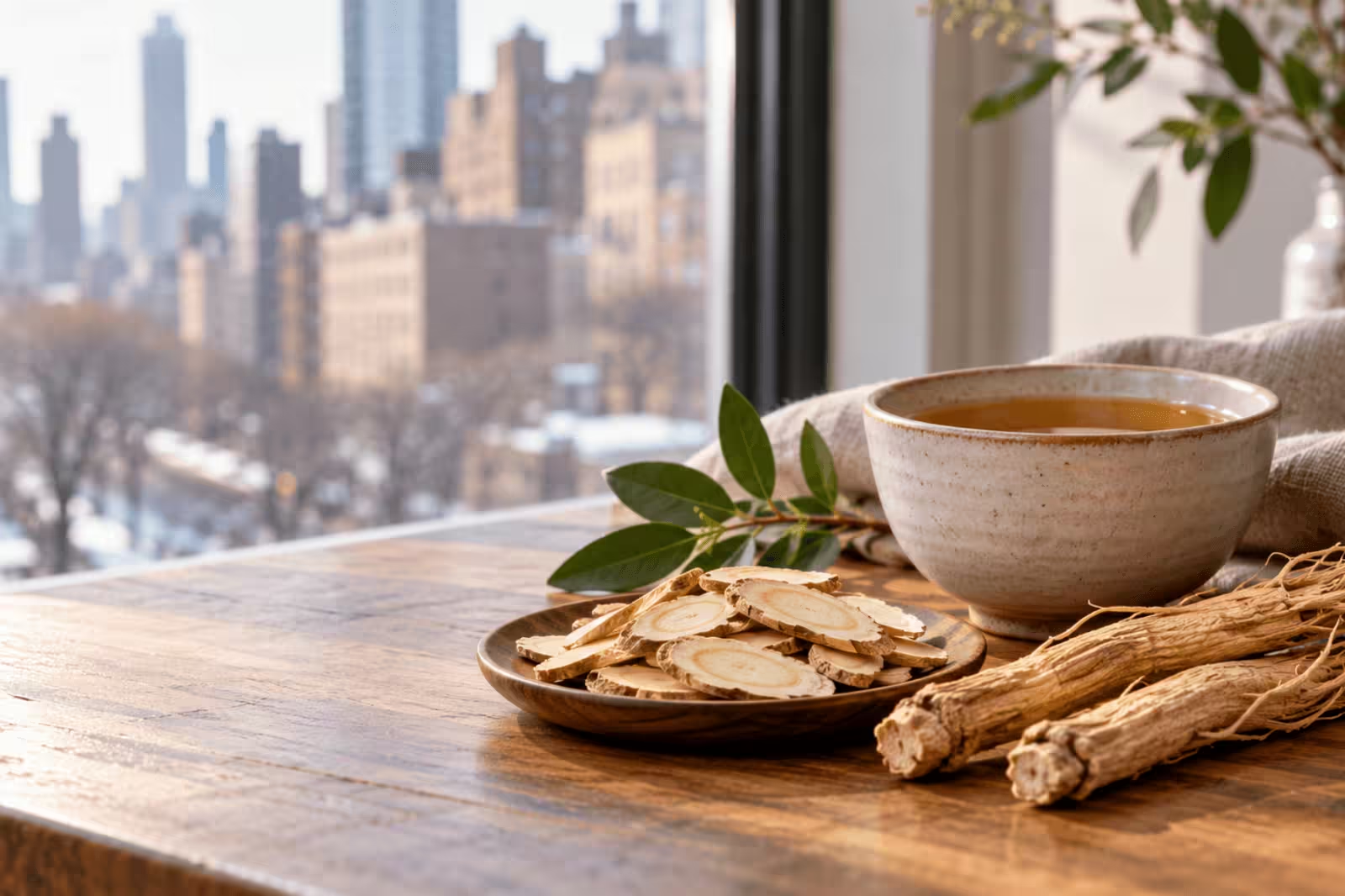
Astragalus, known in Chinese as Huang Qi, is a root traditionally used in Traditional Chinese Medicine to support Qi and vitality. For generations, it has been included in herbal practices that focus on maintaining balance and supporting overall wellness.
During a New York City winter, learning about astragalus can offer a helpful starting point for exploring traditional approaches to seasonal wellness. Our acupuncturists at ACA Acupuncture & Wellness consider each person’s needs and health history when discussing whether an herbal approach may fit their care.
Medical Disclaimer: This article is for educational purposes only and is not medical advice. Consult a qualified healthcare professional before using astragalus, especially if you take medication, have a health condition, are pregnant, or are breastfeeding.
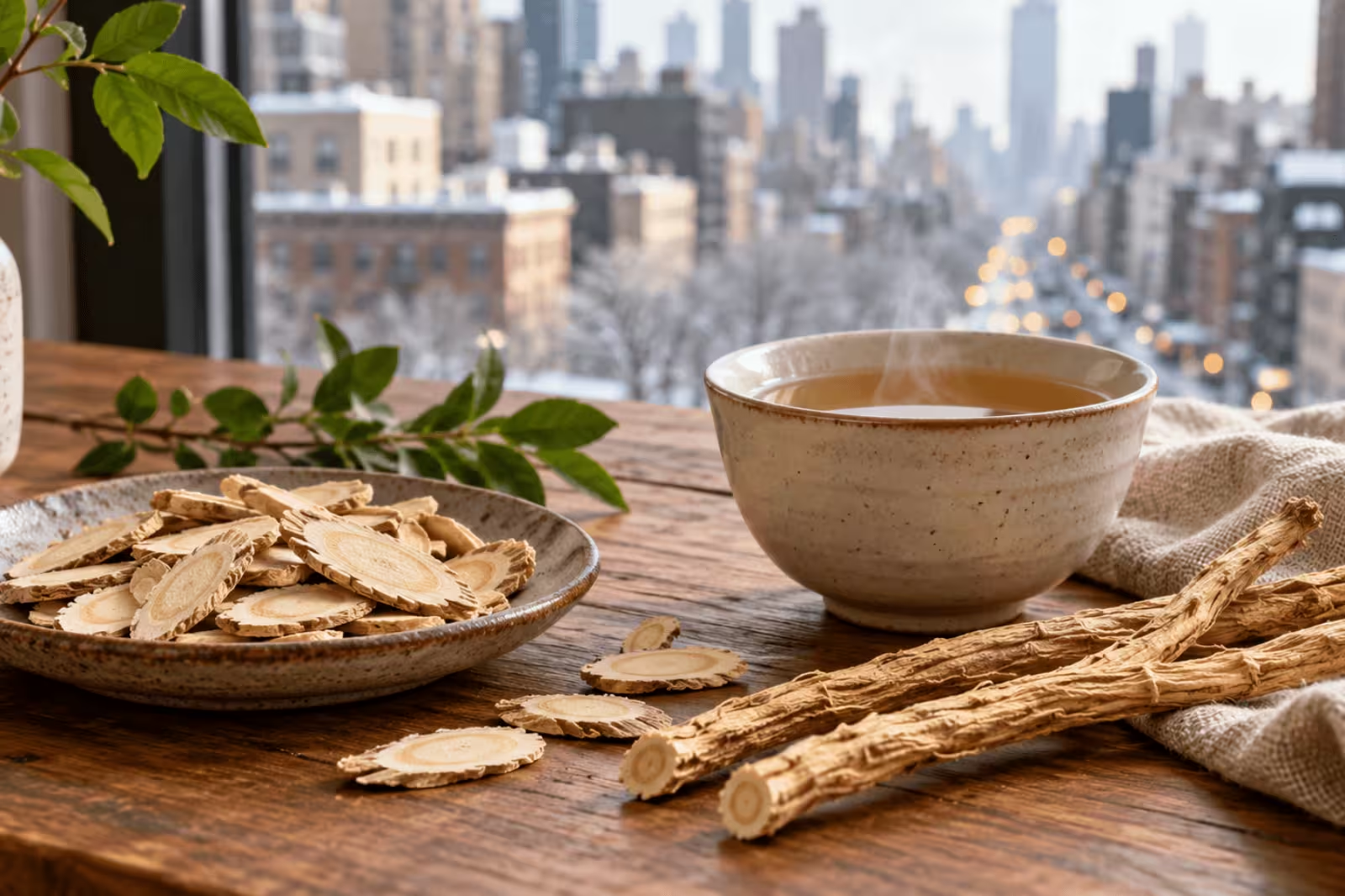
Astragalus is a plant whose root has a long history of use in Traditional Chinese Medicine. Huang Qi, also written as huang qi, is the Chinese name for the medicinal root. The herb is commonly identified with Astragalus membranaceus and Astragalus mongholicus. The exact species and preparation can depend on the product.
The root is the part most associated with astragalus in Chinese herbal practice. It may be sold as dried slices, powder, or an extract. Astragalus leaves are a different part of the plant and should not be assumed to have the same traditional use or composition as the root.
The word “astragalus” on a package does not tell you everything about what is inside. Products may differ in plant species, plant part, preparation, concentration, additional ingredients, and quality. Check the full label, including the ingredient list and serving information.
In TCM, astragalus is traditionally described as a Qi-tonifying herb. Qi is a concept within Chinese medicine used to describe aspects of the body’s activity and vitality. Practitioners may also refer to Wei Qi, a traditional concept associated with the body’s protective functions.
These terms belong to a traditional framework. They are not biomedical measurements or diagnoses, and they do not mean that astragalus has been shown to “boost immunity” in the way that phrase is often used in supplement marketing.
A TCM practitioner considers the person’s overall presentation rather than choosing an herb based on a season or symptom alone. The assessment may include health history, current concerns, medications, digestion, energy, and other factors relevant to the practitioner’s approach. Two people with similar concerns may receive different recommendations.
In Chinese herbal practice, astragalus may be combined with other Chinese herbs. The formula is selected to fit the practitioner’s assessment and the person’s goals. This individualized approach is one reason a single-herb supplement bought over the counter may not reflect how TCM Astragalus is used in a practitioner-guided setting.
If a practitioner discusses an herbal formula with you, ask:
At ACA Acupuncture & Wellness, our acupuncturists can discuss your wellness goals and relevant health history. Bring a list of your medications and supplements so you can have an informed conversation about your care.

Astragalus root is available in several forms. The form affects how it is prepared, but it does not by itself establish the product’s suitability or effectiveness.
Do not assume that a culinary preparation and a concentrated extract have the same strength or safety considerations. Follow the product label and professional guidance, and do not take more than directed.
Astragalus may not be suitable for everyone. Supplements can cause unwanted effects, differ in quality, and interact with medications. Safety depends on the individual and the particular product, so a general statement that an herb is “natural” or “traditional” is not enough to determine whether it is right for you.
Before using astragalus, talk with a healthcare professional if you:
Do not stop or change a prescribed medication to take astragalus. If you already use an astragalus product, bring the package or a clear photo of its label to your healthcare professional. The plant part, other ingredients, and serving instructions can help them review it.
If you develop a concerning reaction after taking a supplement, stop using it and contact a healthcare professional. Seek urgent medical help for severe symptoms.
In Traditional Chinese Medicine, Huang Qi has several traditional functions beyond general Qi tonification. A practitioner may consider it as part of a formula when a person’s pattern and overall health history suggest it may be appropriate:
These are traditional TCM uses, and they do not guarantee a specific result. The choice to use Huang Qi depends on the individual assessment and the other ingredients in the formula.
Traditional Chinese medicine considers seasonal changes when discussing wellness. In a New York City winter, colder commutes, shorter days, and the shift between outdoor chill and heated indoor spaces can all affect daily routines. Seasonal care may include practical changes to clothing, rest, meals, and activity.
Huang Qi is sometimes included in traditional herbal formulas used during colder months, but it is not automatically appropriate just because winter has arrived. Seasonal wellness approaches may consider it when its traditional role fits the person’s needs. Winter alone does not determine whether someone should take it.
There is no single established dose that applies to every astragalus product or person. Products differ in plant part, preparation, concentration, and additional ingredients, and doses used in studies do not automatically provide instructions for personal use. Ask a qualified healthcare professional to review the specific product and your health history before taking it.
Huang Qi is considered within the context of a person’s health history, goals, and current care. If you’re thinking about astragalus or another herbal product, bring its label and your questions to a qualified healthcare professional before using it.
At ACA Acupuncture & Wellness, our practitioners offer acupuncture and holistic care tailored to each person’s needs. These services may complement a broader wellness plan, while medical evaluation and treatment remain important for severe, persistent, or worsening symptoms. Book your appointment to discuss your wellness goals and care options.
No. Astragalus and echinacea are different plants with different traditional uses. They should not be treated as interchangeable, and evidence about one herb does not apply to the other.
Some people may experience mild effects such as nausea, diarrhea, itching, or a rash. Stop taking the product and contact a healthcare professional if you develop a concerning reaction. Seek urgent care for severe symptoms.
People with autoimmune conditions should ask their healthcare professional before using astragalus. Because it may affect immune activity, it might not be appropriate for everyone with an immune-related condition.
Ask a child’s pediatrician before giving them astragalus. Safety and appropriate use can depend on the child’s age, health, and the specific product.
There is no established duration that applies to every person or product. Ask a qualified healthcare professional how long to use the specific preparation and when to review whether it remains appropriate.
Check with a healthcare professional before combining astragalus with other herbs or supplements. Products can contain overlapping ingredients or have effects that may not be suitable for your health needs.
Sources:
National Center for Complementary and Integrative Health. (2025, May). Astragalus.
Zhang, Y., Chen, Z., Chen, L., Dong, Q., Yang, D.-H., Zhang, Q., Zeng, J., Wang, Y., Liu, X., Cui, Y., Li, M., Luo, X., Zhou, C., Ye, M., Li, L., & He, Y. (2024). Astragali radix (Huangqi): A time-honored nourishing herbal medicine. Chinese Medicine, 19(1), Article 119.
Chen, Y., Xie, M., Zhou, S., & Liu, F. (2024). Research state of the herbal medicine Huangqi (Radix Astragali): A global and bibliometric study. Medicine, 103(8), Article e37277.
Li, J., Wu, M., & Liu, W. (2025). Astragalus-containing Chinese herbal medicine used with Western medicine for lupus nephritis: A systematic review and meta-analysis of randomized controlled trials. Frontiers in Pharmacology, 15, Article 1395844.
Sheng, X., Yang, L., Huang, B., Lin, G., Wang, Y., Wu, X., & Lin, R. (2025). Efficacy of Astragalus membranaceus (Huang Qi) for cancer-related fatigue: A systematic review and meta-analysis of randomized controlled studies. Integrative Cancer Therapies, 24, 1–13.

Recent Comments