

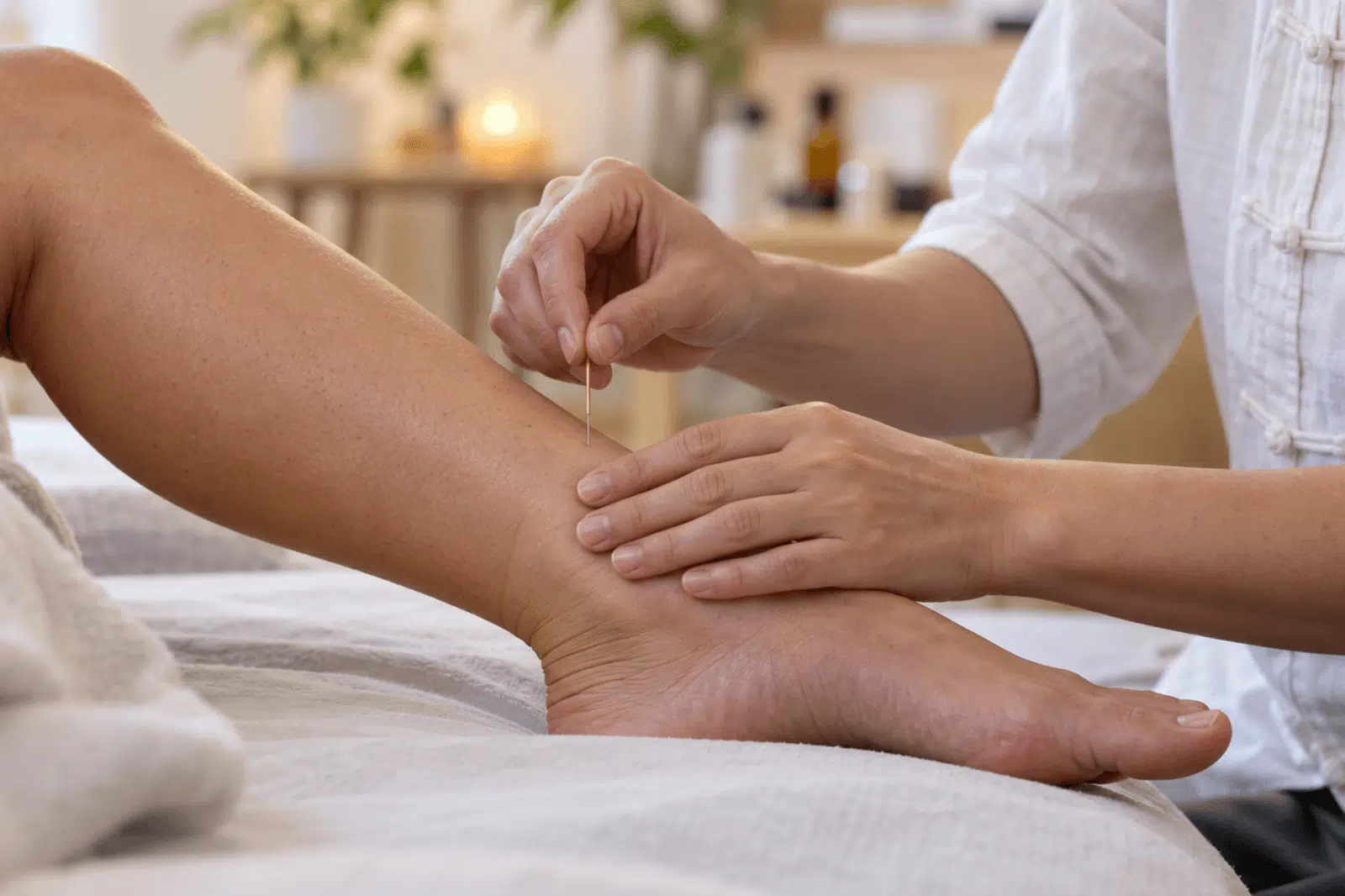
SP6, also called Sanyinjiao or Spleen 6, is an acupuncture point on the inner lower leg. It sits three body-cun above the inner ankle bone, just behind the border of the tibia. In Traditional Chinese Medicine, SP6 is known as the meeting place of the Spleen, Liver, and Kidney Yin channels.
Practitioners commonly include SP6 in treatment plans for menstrual discomfort, pelvic symptoms, digestion, urinary concerns, and sleep problems. Its broad range of traditional uses explains why it appears so often in acupuncture point combinations.
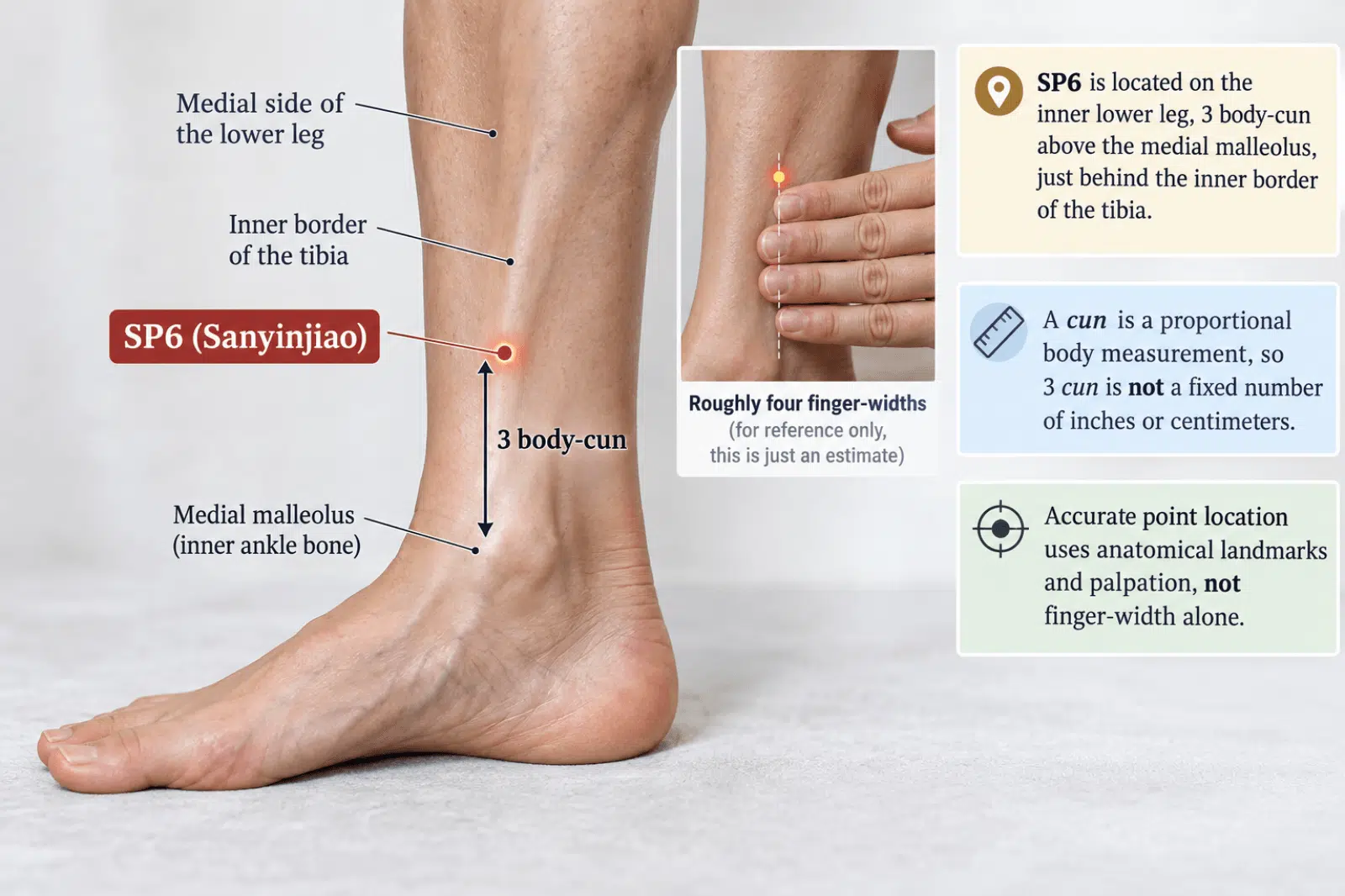
SP6 is found on the medial side of the lower leg. The easiest landmark to identify is the medial malleolus, which is the rounded bone on the inside of the ankle.
From the highest point of that bone, SP6 lies three body-cun higher and just behind the inner border of the tibia.
You may also hear the point described as roughly four finger-widths above the ankle. That description can help you picture the location, but it is only an estimate.
A cun is a proportional measurement used in acupuncture. It changes according to the size of the person being treated, so three cun does not equal one fixed number of inches or centimeters.
An acupuncturist also uses touch and anatomical landmarks when locating the point. This matters because the inner lower leg contains nerves, blood vessels, muscle, and connective tissue. Accurate placement involves more than counting finger widths from the ankle.
Sanyinjiao translates to “Three Yin Intersection.” The name comes from the traditional view that the Spleen, Liver, and Kidney Yin channels meet in this area of the lower leg.
Each channel has its own role within Chinese medicine.
The Spleen channel is associated with digestion, nourishment, and the movement of fluids. The Liver channel is connected with the movement of qi and blood and has a close relationship with menstrual function. The Kidney channel is linked with reproduction, urination, and constitutional health.
The meeting of these three channels gives SP6 a broad place in traditional treatment planning.
Traditional acupuncture meridian pathways also help explain why a point on the lower leg may be selected for symptoms felt in the abdomen, pelvis, or another part of the body.
The channel names should not be taken literally as descriptions of Western anatomy. Needling SP6 does not mean a needle reaches or directly treats the spleen, liver, or kidneys.
In Traditional Chinese Medicine, SP6 is valued for its connection to the Spleen, Liver, and Kidney channels. It is traditionally used to support menstrual health, digestion, fluid balance, and overall well-being. Practitioners may include SP6 in acupuncture treatments based on a patient’s symptoms and individual health needs.
Menstrual discomfort is one of the areas most closely associated with SP6.
The point may be included when cramping occurs before or during menstruation, especially when pain appears alongside bloating, digestive changes, lower abdominal tension, or changes in menstrual flow.
Clinical trials involving SP6 have also focused heavily on menstrual pain. Across these trials, acupuncture and acupressure at SP6 have been linked with reductions in pain for some participants. Treatment methods and outcomes have varied, so SP6 should be viewed as one possible part of care rather than a guaranteed solution.
Acupuncture and acupressure are also different techniques.
Acupuncture involves the insertion of sterile needles by a trained practitioner. Acupressure uses pressure applied through the skin with a finger, thumb, or another noninvasive method.
Both may target the same point, but the experience and method of stimulation differ.
SP6 also appears among commonly used pressure points for menstrual cramps, often alongside points chosen according to the location and character of the discomfort.
Severe menstrual pain deserves medical attention, especially when it begins suddenly, worsens over time, interferes with normal activities, or appears with very heavy bleeding. Conditions such as endometriosis, adenomyosis, and uterine fibroids can also cause menstrual pain.

SP6 may therefore be included when a patient reports bloating, loose stools, poor appetite, abdominal fullness, or a heavy feeling in the body.
This does not mean SP6 treats every digestive problem. A practitioner looks at the whole pattern before deciding whether the point fits.
The presence of nausea, reflux, bowel changes, fatigue, appetite changes, abdominal discomfort, and other symptoms may alter the point combination used during treatment.
Fluid-related symptoms may also influence point selection. Swelling and a feeling of heaviness can fit certain traditional patterns, but unexplained or severe swelling should not be treated as a simple acupuncture issue without proper medical assessment.
SP6 sits in an area of the lower leg that has an interesting relationship with pelvic nerve pathways.
The tibial nerve travels through the medial lower leg and has connections with nerve networks involved in bladder and pelvic function. This anatomical relationship has drawn attention because stimulation of tibial nerve pathways is also used in some medical approaches for urinary symptoms.
Acupuncture at SP6 and medical tibial nerve stimulation are not the same treatment. They use different techniques and follow different clinical frameworks.
Still, the anatomy helps explain why the inner lower leg continues to receive attention in both traditional acupuncture and modern pelvic care.
For patients with urinary urgency, frequency, pain, leakage, or repeated infections, acupuncture should complement appropriate medical evaluation rather than replace it.
SP6 may also appear in acupuncture plans for people who have trouble falling asleep, staying asleep, or settling at night.
Trials using SP6 for sleep have reported encouraging results, but the body of evidence remains smaller than it is for menstrual pain. Sleep problems also have many possible causes, which makes a full assessment useful.
Pain, anxiety, stress, medication effects, caffeine intake, hormonal changes, breathing disorders, and irregular sleep schedules can all affect sleep quality.
An acupuncturist may therefore use SP6 as one point in a wider combination rather than treating insomnia with SP6 alone. The PC6 acupuncture point may also be included when sleep difficulties are accompanied by stress, anxiety, or restlessness.
A properly placed acupuncture needle at SP6 should not cause strong, sharp pain.
You may notice a dull ache, heaviness, pressure, warmth, tingling, or a mild spreading sensation in the lower leg. Acupuncture practitioners often use the term deqi for this type of sensation.
Some people barely feel the needle.
Sharp, burning, strongly electric, or persistent pain is different. Tell the practitioner if you experience one of these sensations so the needle can be adjusted or removed.
There is no advantage to tolerating pain during treatment.

Important pregnancy safety precaution: If you are pregnant or think you may be pregnant, avoid stimulating SP6 with acupressure at home unless your maternity clinician and a qualified acupuncture practitioner have advised that it is appropriate. Do not use SP6 to try to induce labor without obstetric supervision.
SP6 has a long history of cautious use during pregnancy because traditional acupuncture texts connect the point with the uterus, pelvic activity, and labor.
That history has led many practitioners to avoid strong stimulation of SP6 during certain stages of pregnancy or to use the point only when there is a clear clinical reason.
Available safety data do not show that SP6 reliably starts labor or that properly performed acupuncture at traditionally restricted points automatically causes pregnancy complications.
Even so, pregnancy changes the way acupuncture should be planned.
Tell your acupuncturist if you are pregnant, how far along you are, and whether you have had bleeding, contractions, placenta problems, cervical concerns, high blood pressure, or other pregnancy complications.
Trying to stimulate SP6 at home to start labor is not a substitute for obstetric advice. Labor timing and pregnancy safety should remain under the care of an appropriate maternity clinician.
SP6 can also be stimulated without needles. However, pregnant patients should consult an appropriate healthcare professional before applying pressure to this point.
For acupressure, a person can place a thumb or finger over the point and apply gentle, steady pressure. The pressure should feel comfortable rather than painful.
Stronger pressure does not automatically produce a better effect.
Stop if you feel sharp pain, numbness, burning, or an electric sensation that travels into the foot or leg.
Do not try to insert needles yourself. Acupuncture requires training in anatomy, hygiene, needle placement, depth, and patient safety.
Avoid pressing SP6 over broken skin, infection, recent injury, painful veins, or heavily swollen tissue.
One-sided leg swelling with warmth, redness, tenderness, or calf pain needs medical assessment. Those symptoms can have causes that should not be managed with massage or pressure-point techniques.
Pregnant patients should ask a qualified clinician before using SP6 for pelvic symptoms or labor-related purposes.
Knowing where SP6 is located does not tell you whether it belongs in your treatment.
Acupuncturists rarely build a session around one point alone. They look at how symptoms fit together and select a group of points that matches the patient’s needs.
A person with menstrual cramps and digestive discomfort may receive a different combination from someone who has menstrual pain with sleep problems. The same applies to pelvic, urinary, and digestive symptoms.
Health history matters too. Medications, pregnancy, recent surgery, chronic illness, skin problems, and other factors can change how treatment is planned.
This is why point charts work best as educational tools rather than self-treatment instructions.
Yes. A small bruise can occasionally develop after acupuncture if the needle contacts a tiny blood vessel. Mild bruising is usually temporary and should fade on its own. Tell your practitioner if you develop significant swelling, worsening pain, persistent bleeding, or a large bruise after treatment.
Yes. A matching SP6 point is found on each lower leg. A practitioner may use one side or both depending on the treatment plan.
SP6 has been used for menstrual discomfort for a long time, and clinical trials involving acupuncture or acupressure at the point have reported reductions in menstrual pain for some patients. Results vary from person to person.
SP6 has a traditional connection with labor, but it does not reliably start labor. Pregnant patients should avoid using the point as a do-it-yourself induction method.
The word “Spleen” refers to the traditional Spleen channel. It does not describe the physical location of the spleen and does not mean a needle placed at SP6 reaches the organ.
No. Most acupuncture treatments combine SP6 with other points chosen around the patient’s symptoms, history, and treatment goals.
SP6 may be a useful part of acupuncture care, but its use depends on your symptoms, health history, pregnancy status, and treatment goals.
At ACA Acupuncture & Wellness, our practitioners take a personalized approach to acupuncture, considering your overall health when selecting points such as SP6. Treatment may be tailored to concerns such as menstrual discomfort, pelvic symptoms, digestive problems, sleep difficulties, muscle tension, and stress.
If you’re experiencing ongoing symptoms or would like to know whether SP6 may be appropriate for you, schedule an acupuncture appointment with us today. Our team can assess your needs and develop a treatment plan tailored to your health goals.
Sources:
Carr, D. J. (2015). The safety of obstetric acupuncture: Forbidden points revisited. Acupuncture in Medicine, 33(5), 413–419.
Ravi, P., Boopalan, D., Vijayakumar, V., Anandhan, A., Vanamoorthy, M. K., Chidambaram, Y., Kasi, M., & Kuppusamy, M. (2024). Effect of Sanyinjiao (Spleen-6) acupoint for pain management in primary dysmenorrhea: An updated systematic review and meta-analysis. Medical Acupuncture, 36(4), 178–188.
Wang, Z. J., Zhang, Y., Guo, W., Zhuang, L. X., Gao, X., Willcox, M. L., & Hu, X. Y. (2020). Is single acupoint Sanyinjiao (SP 6) effective in managing insomnia? A systematic review of randomized controlled trials. Global Health & Medicine, 2(4), 212–220.

Recent Comments