
Cupping therapy points are specific muscles, trigger points, or soft tissue zones where cups are placed to reduce tension, improve local circulation, support recovery, and ease pain. Practitioners choose these points based on where you feel discomfort, how your body moves, which tissues feel restricted, and which areas need decompression or soft tissue support.
Cupping is best understood as a targeted therapy rather than a random placement of cups. The goal is to create suction over areas that may benefit from improved blood flow, reduced tightness, and soft tissue release. It is commonly used on the back, neck, shoulders, hips, legs, chest, abdomen, face, and head, but the safest and most effective point selection depends on the person, the condition, and the practitioner’s training.
Cupping therapy points are specific muscles, trigger points, or soft tissue zones where cups are placed to reduce tension, improve local circulation, support recovery, and ease pain. Practitioners choose these points based on where you feel discomfort, how your body moves, which tissues feel restricted, and which areas need decompression or soft tissue support.
Cupping is best understood as a targeted therapy rather than a random placement of cups. The goal is to create suction over areas that may benefit from improved blood flow, reduced tightness, and soft tissue release. It is commonly used on the back, neck, shoulders, hips, legs, chest, abdomen, face, and head, but the safest and most effective point selection depends on the person, the condition, and the practitioner’s training.
Cupping therapy points are the areas where a practitioner places cups to create suction on the skin and underlying soft tissue. These points may be small and specific, such as a trigger point in the upper trapezius, or broad and regional, such as the lower back, hamstrings, or shoulder blade area.
In modern musculoskeletal care, cupping points are often selected around muscles, fascia, and painful movement patterns. The practitioner may focus on areas where the tissue feels tight, guarded, tender, restricted, or overworked.
A practical way to understand cupping points is this: they are not always “dots.” They are treatment targets. A cup may be placed over a tight band of muscle, a tender knot, a stiff joint region, a fascial line, or a broader soft tissue zone that influences comfort and movement.
Common examples include:
Cupping points are chosen by matching the treatment area to the person’s symptoms, body mechanics, and safety profile. A skilled practitioner does not simply place cups where pain is strongest. They look for the tissues that may be contributing to the pain.
A practitioner may consider:
For example, a person with neck pain may need cups on the upper trapezius, levator scapulae, shoulder blade region, and upper back rather than only the neck. A runner with knee discomfort may need work around the quadriceps, calves, hip muscles, and outer thigh instead of direct treatment over the knee joint.
This is where cupping becomes more precise. The best cupping points are often the points that explain why the body is overworking, not just where the discomfort is felt.
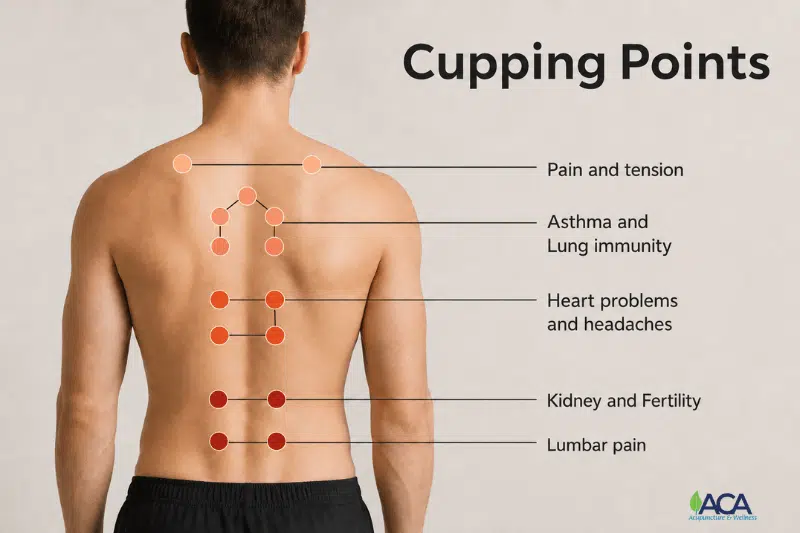
Back cupping points are among the most common because the back contains large muscle groups, layered fascia, postural stress points, and many areas where people hold chronic tension. Cupping on the back is often used for low back pain, upper back tightness, muscle spasms, postural strain, and recovery after physical activity.
Research on cupping for pain remains mixed, but low back pain is one area with relatively more supportive evidence. A systematic review and meta-analysis reported that cupping may improve pain and disability in people with low back pain, while broader pain reviews still note that the overall evidence ranges from very low to moderate quality.
Upper back cupping points usually include the trapezius, rhomboids, levator scapulae, and upper thoracic paraspinal muscles. These areas often become tight from computer work, phone use, driving, lifting, stress, and rounded shoulder posture.
Upper back cupping may be used for:
The upper back is also a common area for sliding cupping because the cups can move across broad muscle layers. This may feel like a pulling version of massage, especially when oil is used and the practitioner keeps the suction controlled.
Middle back cupping points are often placed along the thoracic paraspinals, between the shoulder blades, and sometimes around the rib-supporting muscles. This region is important for spinal rotation, upright posture, and comfortable breathing mechanics.
Middle back cupping may be used for people who feel:
Cupping in this area should be comfortable and controlled. The practitioner should avoid excessive suction over bony prominences and should adjust pressure if the person feels sharp pain, burning, dizziness, or unusual discomfort.
Lower back cupping points commonly include the lumbar paraspinals, quadratus lumborum, sacroiliac region, and upper gluteal area. These areas are often involved in low back tightness, sitting-related stiffness, lifting strain, and hip-related compensation patterns.
Lower back cupping may be used for:
The lower back should not be treated aggressively in everyone. People who are pregnant, have unexplained abdominal or pelvic symptoms, have acute injury, have nerve symptoms, or have severe pain should be screened carefully and referred for medical evaluation when appropriate.
Neck and shoulder cupping points are often chosen for people with desk posture, tech neck, stress tension, headaches, and restricted shoulder movement. The most common areas include the upper trapezius, base of the neck, levator scapulae, shoulder blade muscles, and sometimes the front chest muscles that contribute to rounded shoulder posture.
Cupping in this area should be precise and moderate. The neck contains sensitive structures, and cups should not be placed directly over major vessels, the front of the throat, irritated skin, or areas that feel sharp or neurologic.
The upper trapezius is one of the most common cupping points for neck and shoulder tension. This muscle often becomes overactive when a person works at a computer, clenches the jaw, drives for long periods, or carries stress in the shoulders.
Cupping in this area may help reduce the feeling of “shoulders up by the ears.” It may also support short-term comfort when paired with stretching, posture work, mobility exercises, ergonomic changes, or other supportive care.
The shoulder blade region includes the rhomboids, infraspinatus, teres muscles, lower trapezius, and surrounding fascia. These points may be used when the shoulder feels stuck, the upper back feels dense, or pain sits between the shoulder blades.
This is a useful area for people who lift weights, carry children, work at a desk, play racquet sports, or experience upper back tension after repetitive arm use.
Shoulder discomfort is not always only a back-body problem. The pectoralis major and pectoralis minor can contribute to rounded shoulders, restricted breathing mechanics, and front shoulder tightness.
Gentle cupping around the upper chest may be used in some cases, but this area requires careful technique. Cups should not be placed over breast tissue, irritated skin, open wounds, or sensitive medical areas. Pressure should be lighter than what might be used on the back.
Leg and hip cupping points are commonly used for athletes, runners, cyclists, lifters, and people who stand or walk for long hours. These points are usually selected around large muscle groups rather than directly over bony joints.
Cupping in the lower body may focus on:
The goal is often to reduce soft tissue tension, support mobility, and improve comfort during movement.
Hamstring and glute cupping points are often used when the back of the legs feels tight, the hips feel restricted, or the low back is compensating for poor hip mobility. These areas are especially common in runners, weightlifters, cyclists, and people who sit for many hours.
Glute points may also be relevant when tension travels from the low back into the hip or outer thigh. However, radiating pain, numbness, tingling, weakness, or worsening leg symptoms should be medically assessed.
The IT band is a dense connective tissue structure along the outer thigh. It can feel tender, tight, or irritated in runners and cyclists. Practitioners often cup around the IT band and related tissues rather than applying strong suction directly to the most painful line.
Important surrounding areas include:
This broader approach often makes more sense than chasing one sore strip of tissue.
Calf cupping points are often used for tight calves, running recovery, ankle stiffness, and lower leg fatigue. Treatment may focus on the gastrocnemius, soleus, and surrounding fascia.
Cupping should not be placed over varicose veins, unexplained swelling, suspected blood clots, skin infections, or acute calf pain. Calf pain with warmth, redness, swelling, or shortness of breath requires urgent medical attention rather than bodywork.
Cupping is usually not placed directly over the kneecap or bony hip points. Instead, practitioners often work around the muscles that influence the joint.
For knee support, points may include the quadriceps, hamstrings, calves, adductors, and outer thigh. For hip support, points may include the glutes, hip flexors, tensor fasciae latae, and low back.
This approach respects the joint as part of a movement system. The knee and hip often hurt where the stress shows up, but the cause may involve muscles above or below the joint.
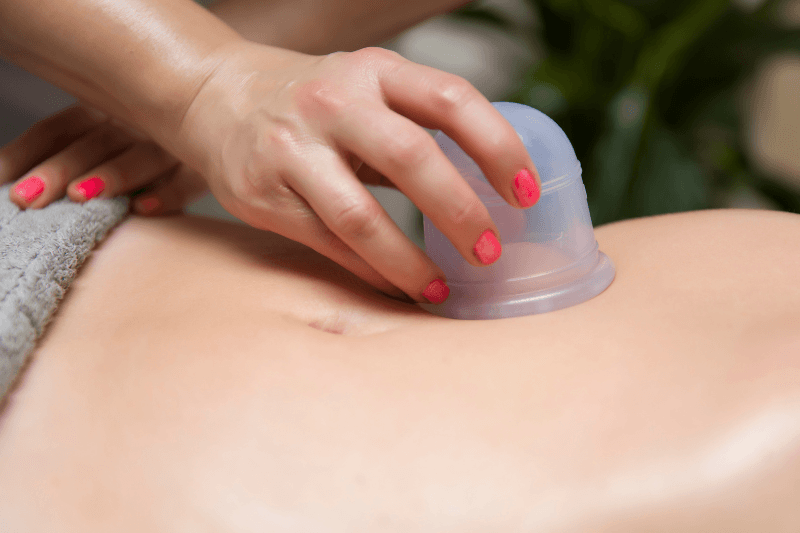
Chest and abdominal cupping points require a gentler approach than the back or legs. These areas are more sensitive and may involve organs, ribs, breast tissue, digestive symptoms, scars, hernias, pregnancy considerations, or medical conditions.
Chest cupping points may be used around the pectoral muscles and rib-adjacent tissues to address chest wall tightness, rounded posture, or breathing-related muscular restriction. This does not mean cupping treats asthma, bronchitis, or other respiratory disease directly.
A safer and more accurate way to describe this use is that cupping may help release soft tissue tension around the chest wall, which may make breathing mechanics feel less restricted for some people. Medical respiratory conditions still require medical care.
Abdominal cupping points may be used gently for abdominal wall tension, stress-related tightness, or digestive wellness support. These points should be approached conservatively.
Abdominal cupping is not appropriate over acute abdominal pain, unexplained swelling, pregnancy unless specifically cleared and appropriately trained, hernias, recent surgery, active digestive disease flares, or any symptom that has not been evaluated when evaluation is needed.
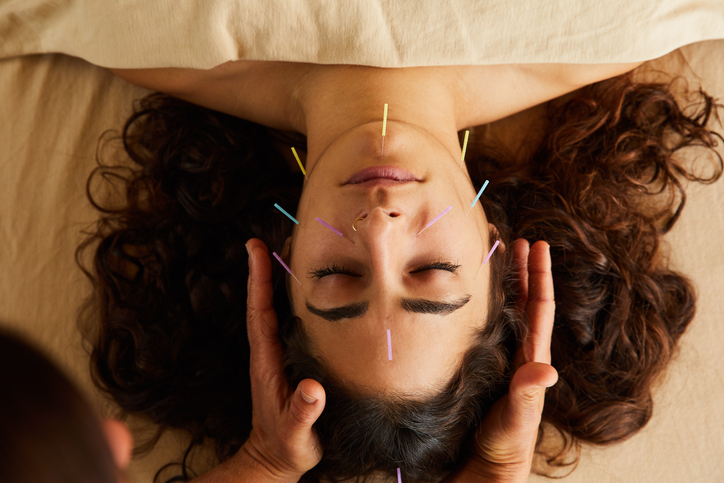
Facial cupping uses smaller cups and much lighter suction than body cupping. It is commonly used around the jawline, cheeks, temples, forehead, and under-cheek areas. The goal is usually gentle circulation support, puffiness reduction, facial muscle relaxation, or tension relief.
Facial cupping should not leave strong dark marks when performed properly. It is usually done with gliding movements rather than stationary cups.
Jawline cupping points may be used around the masseter and lower cheek area for people who clench their jaw, grind their teeth, or hold facial tension. Cupping is not a replacement for dental or TMJ evaluation, but it may complement a broader care plan when muscular tension is part of the picture.
Gentle facial cupping may be applied around the temples, forehead, and cheek areas. Some people seek this for sinus pressure, facial puffiness, or tension headaches. Pressure must be light, and cups should not be placed over the eyes, inflamed skin, broken capillaries, active acne lesions, or recent cosmetic procedure areas unless cleared by a qualified professional.
The National Center for Complementary and Integrative Health notes rare but serious adverse events have been reported, including bleeding inside the skull after cupping on the scalp, which is one reason head and scalp cupping require caution and appropriate training.
Different cupping methods are used for different goals. The same point may be treated with light, moderate, stationary, or moving suction depending on the person’s sensitivity and treatment plan.
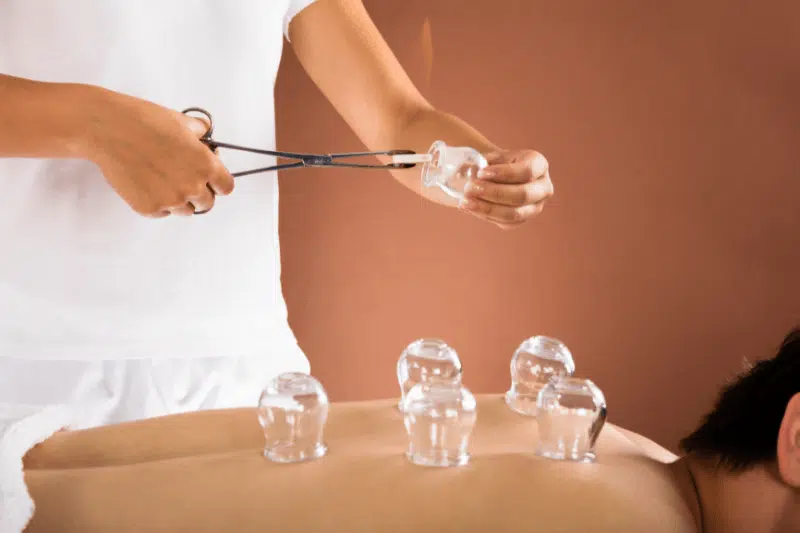
Dry cupping uses suction without drawing blood. Cups may stay in place for several minutes over selected points. This is commonly used on the back, shoulders, hips, and legs.
Dry cupping is often selected for tight muscles, trigger points, soreness, and localized tension.
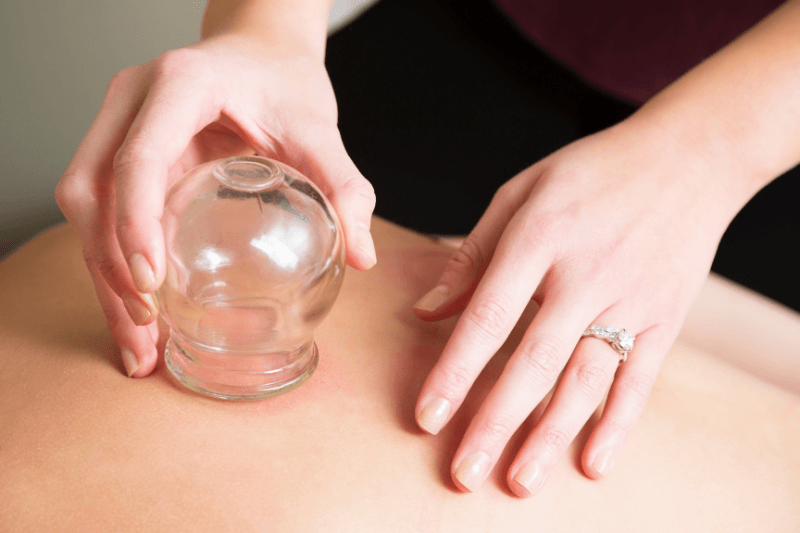
Sliding cupping uses oil or lotion so the practitioner can glide the cup across a larger area. This method is often used on broad muscle groups such as the back, hamstrings, calves, or shoulders.
Sliding cupping may feel more like deep tissue massage with suction. It is useful when the goal is to treat a wider fascial region instead of one isolated point.
Flash cupping involves quickly placing and removing cups. It is usually lighter and more stimulating than prolonged stationary cupping. It may be used when a person is sensitive, when the practitioner wants a gentler technique, or when strong marks are not desired.
Facial cupping uses small cups and light suction. It is typically performed with movement and should not create the same deep circular marks often seen after body cupping.
Wet cupping, also called hijama in some traditions, involves superficial punctures and removal of small amounts of blood. It requires strict hygiene, appropriate training, and careful screening. It is different from dry cupping and is not appropriate for everyone.
Because wet cupping can involve blood exposure, people should only seek it from properly trained providers who follow infection control standards.
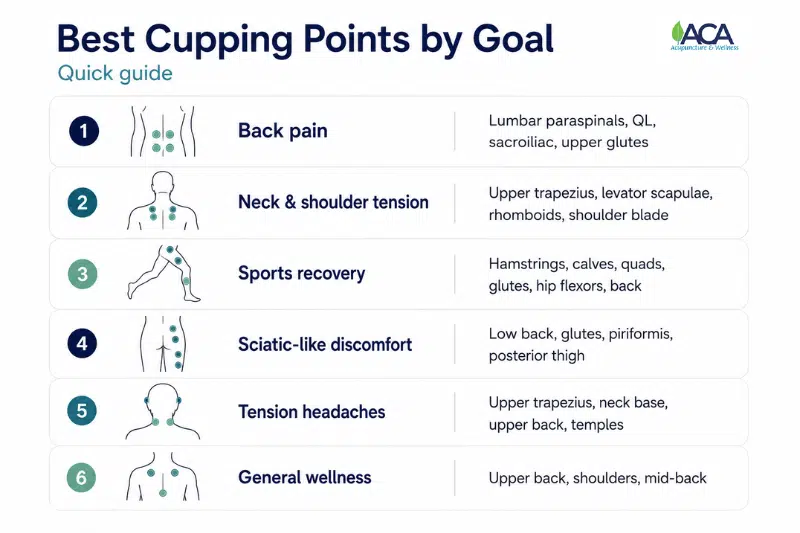
The best cupping points depend on the goal of the session. A pain relief treatment is different from a sports recovery session, and facial cupping uses a much lighter approach than lower back or leg cupping. The table below gives a quick overview of common cupping point strategies before the sections explain each goal in more detail.
|
Goal |
Common Cupping Points |
Why These Areas Are Used |
|
Back pain |
Lumbar paraspinals, quadratus lumborum, sacroiliac region, upper glutes |
These areas often hold tension from sitting, lifting, posture strain, or hip compensation. |
|
Neck and shoulder tension |
Upper trapezius, levator scapulae, rhomboids, shoulder blade region |
These muscles commonly tighten from desk work, stress, phone use, and rounded posture. |
|
Sports recovery |
Hamstrings, calves, quads, glutes, hip flexors, back |
These larger muscle groups often become sore, tight, or overworked after training. |
|
Sciatic-like discomfort |
Low back, glutes, piriformis region, posterior thigh |
These areas may contribute to tension around the sciatic nerve pathway. |
|
Headaches linked to tension |
Upper trapezius, neck base, upper back, temples |
These points may help when headaches are connected to tight neck, shoulder, or facial muscles. |
|
General wellness |
Upper back, shoulders, mid-back |
These areas often hold everyday stress and postural tension. |
For back pain, common cupping points include the lumbar paraspinals, quadratus lumborum, sacroiliac region, thoracic paraspinals, and upper glutes.
These points are often used when low back pain is linked with muscle tightness, prolonged sitting, lifting strain, or limited hip mobility.
For neck and shoulder tension, common points include the upper trapezius, levator scapulae, rhomboids, infraspinatus, and upper thoracic region. Some people also benefit from gentle work around the pectoral muscles when rounded shoulders contribute to the problem.
For sports recovery, cupping points often include the hamstrings, quads, calves, glutes, hip flexors, and back. The selected points depend on the sport.
Runners often need calves, hamstrings, glutes, and outer hip support. Lifters often need back, shoulders, hips, and quads. Cyclists often need hip flexors, quads, glutes, and upper back support.
Current research in musculoskeletal and sports rehabilitation suggests cupping has low to moderate evidence and may be useful for decreasing pain and improving blood flow, although study quality and outcomes vary.
For tension-related headaches, cupping points may include the upper trapezius, suboccipital area near the base of the skull, neck-supporting muscles, and upper back. Facial cupping may also be used gently around the temples and forehead.
Headaches with sudden onset, neurological symptoms, fever, head injury, vision changes, or unusual severity require medical evaluation.
For general wellness, practitioners often choose points on the upper back, shoulders, and mid-back. The goal may be relaxation, nervous system downshifting, muscle release, or improved body awareness.
This is one area where cupping should be described carefully. It may help a person feel relaxed and less physically tense, but it should not be presented as detoxification or disease treatment.
A cupping session is not just about placing cups wherever the body feels sore. It begins with identifying the most useful cupping therapy points for your symptoms, movement patterns, muscle tension, and safety needs.
The practitioner may ask about your pain location, health history, medications, skin sensitivity, and treatment goals. They may also check posture, range of motion, tight muscles, tender spots, trigger points, and areas where movement feels restricted. This helps them decide whether the cups should be placed directly around the painful area, around supporting muscles, or along a broader soft tissue pattern.
For example, low back discomfort may involve cupping points around the lumbar muscles, quadratus lumborum, sacroiliac area, and upper glutes. Neck and shoulder tension may involve the upper trapezius, levator scapulae, rhomboids, and shoulder blade region. Leg tightness may involve the calves, hamstrings, quads, glutes, or hip flexors.
During treatment, cups may be placed over:
You may feel pulling, warmth, pressure, stretching, mild tenderness, or a deep release sensation at the treated points. Cupping should not feel sharp, burning, electric, or intolerable. If it does, the practitioner should reduce suction, change the cup placement, or remove the cup.
Stationary cupping usually keeps cups on selected points for a few minutes. Sliding cupping moves across a larger muscle area, such as the back, shoulders, calves, or hamstrings. Facial cupping uses smaller cups, lighter suction, and gentler movement because the points on the face are more delicate.
After treatment, the practitioner may recommend hydration, gentle movement, avoiding intense heat for a short period, and watching the skin around the treated points. A good session should feel specific, intentional, and adjusted to how your body responds.
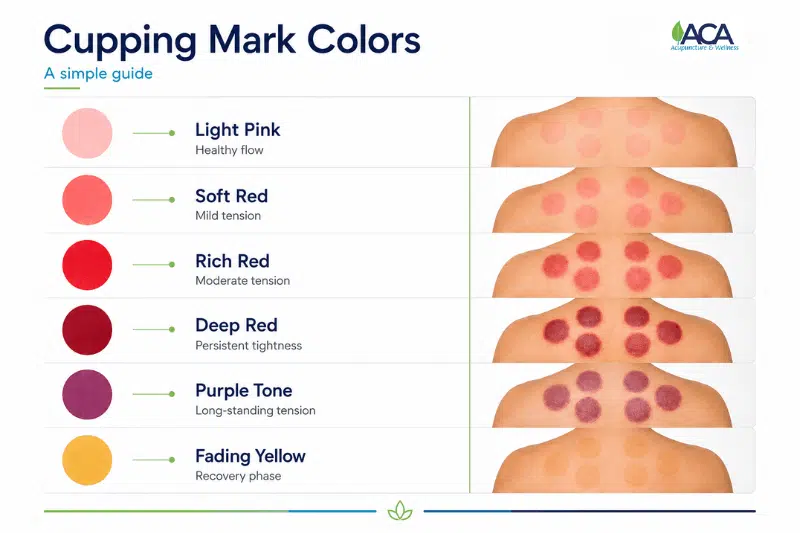
Marks can appear on cupping therapy points after stationary body cupping. They usually form where suction was strongest, where cups stayed on longer, or where the tissue was more sensitive. These marks are a skin response to suction, not proof that toxins were removed.
The color and intensity of the marks can vary from person to person and from point to point. A cup placed on the upper back may leave a different mark than one placed on the calf, glute, shoulder, or lower back. Skin tone, suction strength, tissue sensitivity, and treatment time all affect how marks look.
Marks may appear pink, red, purple, or dark and often fade within several days. Some may last longer, especially if stronger suction was used or the skin is more sensitive.
Safe point selection helps reduce unnecessary irritation. Cups should not be placed over open wounds, active rashes, irritated skin, burns, varicose veins, unexplained swelling, or areas that bruise easily.
Seek help if a treated point develops severe pain, blistering, spreading redness, pus, fever, unusual swelling, or marks that worsen instead of fading.
Not every area of the body is a safe cupping therapy point. A trained practitioner should know which points can be treated, which points need lighter pressure, and which areas should be avoided completely.
Cupping points may need to be avoided or modified over:
Some people may also need extra caution with cupping overall, including those with blood clotting disorders, those taking blood-thinning medication, those with fever or acute illness, and those with severe cardiovascular disease unless cleared by a medical professional.
Certain body areas also require more care. The face, neck, chest, abdomen, and areas near major blood vessels should be treated gently or avoided when risk is higher. Cups should not be placed directly over the eyes, throat, broken skin, bony areas, or medically sensitive spots.
Possible side effects around treated points can include bruising, soreness, skin irritation, itching, burns from improper heat use, infection, or scarring. This is why cupping therapy points should be chosen based on anatomy, skin condition, health history, and comfort level, not just where the strongest suction can be applied.
A qualified cupping practitioner should know how to choose cupping therapy points safely and purposefully. They should not use the same cup placement for every person or treat every painful area the same way.
The right practitioner should be able to explain why they are placing cups on certain muscles, trigger points, or soft tissue zones. For example, they should understand why shoulder pain may involve the upper back and chest, why knee discomfort may involve the quads and calves, or why low back tension may involve the hips and glutes.
Look for someone who:
The best practitioner will personalize cupping therapy points based on your symptoms, tissue response, skin sensitivity, and overall goals. Effective cupping is not about using more cups or stronger suction. It is about choosing the right points, using safe pressure, and adjusting the treatment to your body.
Cupping therapy points work best when they are chosen with purpose. The most useful points are not always the spots that hurt the most. They are the muscles, trigger points, fascial zones, and movement-related areas that help explain why the body feels tight, painful, or restricted.
If your back feels locked up, your shoulders carry stress, or your legs feel heavy after training, cupping therapy may help your body feel less guarded and more mobile. The key is not stronger suction or more marks. It is thoughtful placement, comfortable pressure, and a session tailored to how your body actually responds.
At ACA Acupuncture & Wellness, cupping therapy is used with careful point selection, safe pressure, and your comfort in mind. Curious whether cupping therapy is right for your pain, tension, or recovery goals? Contact ACA Acupuncture & Wellness to ask about cupping therapy or find a convenient location near you.
Sources:
Cleveland Clinic. (2023). Cupping therapy: Definition, types & benefits. Cleveland Clinic.
National Center for Complementary and Integrative Health. (n.d.). Cupping. U.S. Department of Health and Human Services.
Wang, L., et al. (2023). Efficacy of cupping therapy on pain outcomes: An evidence-mapping study. Frontiers in Neurology.
Zhang, Z., Pasapula, M., Wang, Z., Edwards, K., & Norrish, A. (2024). The effectiveness of cupping therapy on low back pain: A systematic review and meta-analysis of randomized controlled trials. Complementary Therapies in Clinical Practice.
Cupping does not literally pull toxins out of the body. The dark circular marks that appear after cupping are caused by suction drawing blood and fluid toward the skin’s surface, not by toxins leaving the body. While cupping may support local circulation and tissue recovery, the body removes waste products through the liver, kidneys, lymphatic system, lungs, and digestive system.
Cupping should not be done over open wounds, active skin infections, burns, rashes, severe eczema or psoriasis flares, varicose veins, blood clots, or areas with unexplained swelling. Practitioners also avoid placing cups directly over the eyes, throat, major arteries, broken skin, bony prominences, and sensitive medical areas. Abdominal and low back cupping should be avoided during pregnancy unless performed by a properly trained practitioner with appropriate clearance.
Cupping marks can show how strongly the skin and superficial blood vessels responded to suction, but they do not diagnose disease or prove that toxins were removed. Light pink or red marks may reflect mild suction or sensitive tissue, while darker purple marks may occur with stronger suction, longer treatment time, or areas of greater tissue congestion. Marks should gradually fade within several days and should not become increasingly painful, swollen, hot, or infected.
Cupping may help reduce muscle tension and fascial tightness around an irritated nerve, but it does not directly “free” a trapped nerve or replace medical care. If nerve entrapment symptoms include numbness, tingling, burning, weakness, radiating pain, or loss of function, the cause should be properly assessed. Cupping may be used as supportive care when soft tissue restriction contributes to nerve irritation, but it should be gentle, targeted, and part of a broader treatment plan.
Cupping may help some people with sciatic-like discomfort, especially when tight muscles in the low back, glutes, hips, or hamstrings are adding tension around the sciatic nerve pathway. In cupping therapy for sciatica, practitioners often place cups around the lumbar paraspinals, gluteal muscles, piriformis region, and posterior thigh rather than directly over the nerve itself. True sciatica can involve disc irritation, nerve compression, or other spinal causes, so severe, worsening, radiating, numb, or weakness-related symptoms should be medically evaluated.
Cupping frequency depends on your symptoms, skin response, and treatment goals. Some people schedule cupping occasionally for muscle tension or recovery, while others may receive it as part of a short care plan for pain or mobility concerns. Strong cupping should not be repeated over the same area until the marks have faded and the skin has fully recovered.
LOCATIONS
MANHATTAN
QUEENS
NEW JERSEY
CALIFORNIA

The over $4 billion US acupuncture market offers a great opportunity with over 10% annual growth rates and a continuing flow of new patients interested in the benefits of acupuncture.
