

The Five Transport Points are five categories of acupuncture points called Jing-Well, Ying-Spring, Shu-Stream, Jing-River, and He-Sea, found along each of the 12 primary channels between the extremities and the elbows or knees. In Chinese Medicine, they describe changing qualities of channel qi through the metaphor of water progressing from a well to a spring, stream, river, and eventually the sea.
Also known as the Five Shu Points or Five Shu-Transporting Points, this system includes 60 acupuncture points in total. Each primary channel contains one point from each of the five categories. The categories also correspond to the Five Phases of Wood, Fire, Earth, Metal, and Water.
Understanding the Five Transport Points provides a useful window into how acupuncture points are organized within traditional Chinese medicine and why two points on the same channel may be selected for very different purposes.
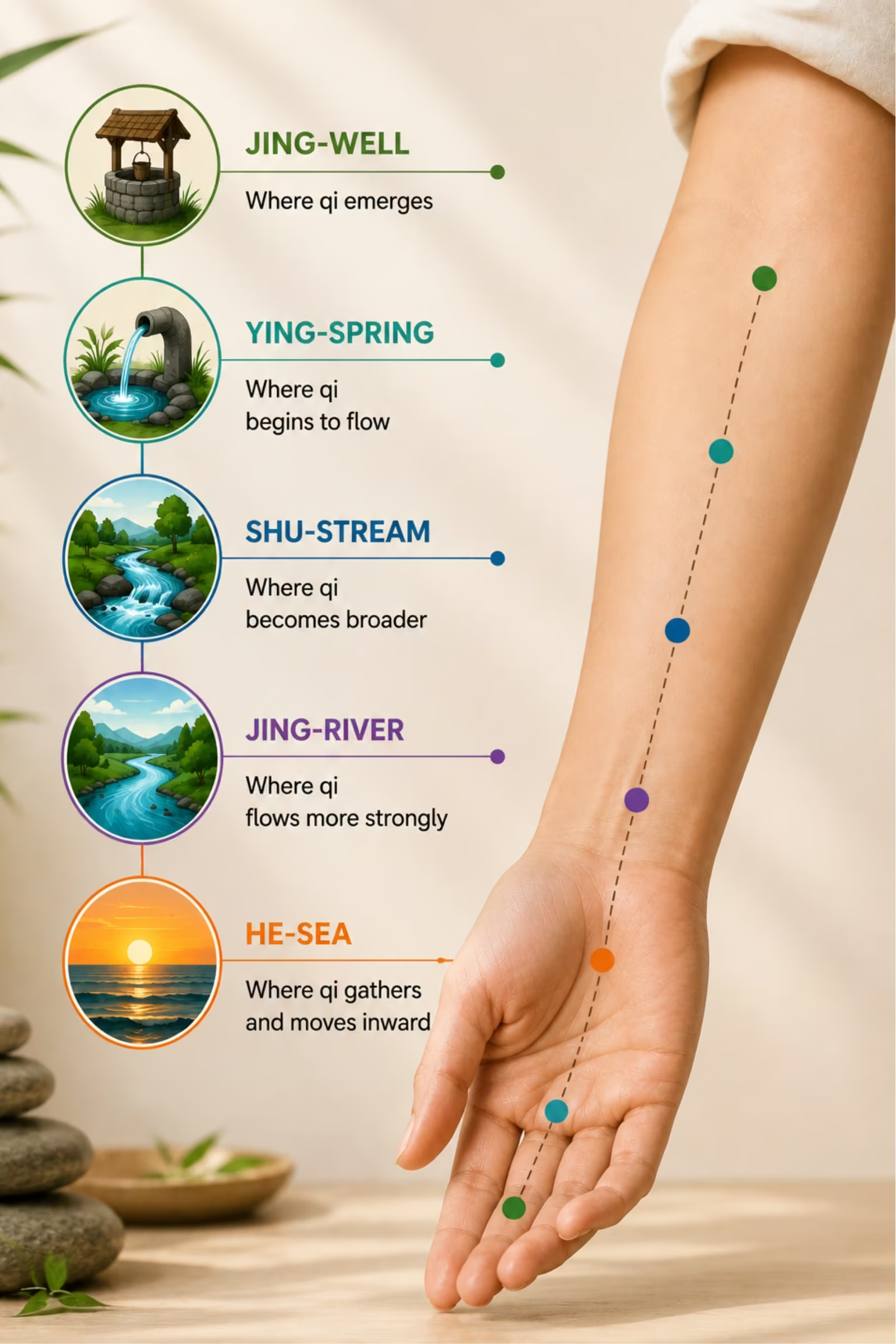
The Five Transport Points are five categories of acupuncture points called Jing-Well, Ying-Spring, Shu-Stream, Jing-River, and He-Sea, found along each of the 12 primary channels between the extremities and the elbows or knees. In Chinese Medicine, they describe changing qualities of channel qi through the metaphor of water progressing from a well to a spring, stream, river, and eventually the sea.
Also known as the Five Shu Points or Five Shu-Transporting Points, this system includes 60 acupuncture points in total. Each primary channel contains one point from each of the five categories. The categories also correspond to the Five Phases of Wood, Fire, Earth, Metal, and Water.
Understanding the Five Transport Points provides a useful window into how acupuncture points are organized within traditional Chinese medicine and why two points on the same channel may be selected for very different purposes.
The Five Transport Points are a traditional classification of acupuncture points situated along the distal portions of the 12 primary channels. They are commonly known as the Five Shu Points, with “Shu” referring to the idea of transporting or conveying.
Every primary channel contains five:
1. Jing-Well – Jing-Well points are the first and most distal of the Five Transport Points. Most are located near the ends of the fingers and toes, with KI-1 being an important exception.
Traditionally, Jing-Well points are associated with fullness below the heart and may also be selected within TCM frameworks involving acute presentations, heat, or disturbances affecting consciousness.
Examples include LU-11 Shaoshang, LI-1 Shangyang, SP-1 Yinbai, LV-1 Dadun, and KI-1 Yongquan.
2. Ying-Spring Points – Ying-Spring points are the second category of the Five Transport Points and are generally located near the fingers and toes.
Traditionally, they are associated with heat of the body and may be considered for heat patterns related to their corresponding channels.
Examples include LU-10 Yuji, LI-2 Erjian, ST-44 Neiting, LV-2 Xingjian, and KI-2 Rangu.
3. Shu-Stream Points – Shu-Stream points are the third category and are traditionally associated with heaviness, joint discomfort, intermittent patterns, and regulation of their corresponding channels.
On the six Yin channels, each Shu-Stream point is also a Yuan-Source point: LU-9, HT-7, PC-7, SP-3, KI-3, and LV-3.
4. Jing-River Points – Jing-River points are the fourth category and are generally located around the wrist, ankle, distal forearm, or lower leg.
Traditionally, they are associated with presentations involving cough, breathing changes, chills and fever, and changes involving the voice.
Examples include LU-8 Jingqu, LI-5 Yangxi, HT-4 Lingdao, ST-41 Jiexi, and LV-4 Zhongfeng.
5. He-Sea Points – He-Sea points are the fifth and most proximal category of the Five Transport Points and are generally located around the elbows and knees.
Traditionally, they are associated with counterflow or rebellious qi, digestive patterns, and certain internal presentations.
Examples include LU-5 Chize, LI-11 Quchi, ST-36 Zusanli, SP-9 Yinlingquan, GB-34 Yanglingquan, and BL-40 Weizhong.
Their names use the movement of water as a metaphor for changes in channel qi. Qi is traditionally described as emerging at the Jing-Well points, gathering at the Ying-Spring points, pouring through the Shu-Stream points, flowing at the Jing-River points, and finally joining or entering more deeply at the He-Sea points.
This classification is different from categories such as Yuan-Source, Luo-Connecting, Xi-Cleft, Front-Mu, and Back-Shu points, although an individual acupuncture point can belong to more than one classification.
For patients, the Five Transport Points help explain why an acupuncturist may choose different points for different people, even when they have similar symptoms.
Rather than matching one acupuncture point to one condition, Traditional Chinese Medicine (TCM) considers the person’s overall pattern, symptoms, and wellness goals. Five Shu classifications can then help guide which points may be appropriate within an individualized treatment plan.
For example, point selection may differ depending on whether care is focused on pain and tension, digestion, sleep, stress, energy, or overall well-being. The Five Transport Points are therefore one part of a broader holistic approach that looks at the whole person rather than an isolated symptom.
Knowing that a point is a Jing-Well or He-Sea point is only one part of point selection.
An acupuncturist may consider several overlapping factors, including:
This helps explain why two people describing similar symptoms may receive different acupuncture point combinations.
It also explains why acupuncture points far from the area of discomfort are sometimes selected. Within traditional channel theory, the location of the symptom is only one consideration.
The Five Transport Points provide a structured way of understanding how acupuncture points along the limbs relate to one another.
Rather than viewing each point as an isolated location, the system places it within a larger network of relationships involving the 12 primary channels, Five Phases, traditional functions, point classifications, and changing qualities of channel qi.
The water metaphor makes those relationships easier to visualize. Qi begins at the extremities like water emerging from a well, becomes progressively broader and deeper, and eventually gathers like water reaching the sea.
For students of acupuncture, this framework helps organize a large amount of point theory. For patients, it offers an explanation for why acupuncture point selection can involve locations that seem far removed from the symptom itself.
Patients do not need to understand or memorize all 60 Five Transport Points to receive acupuncture.
The important point is that acupuncture treatment is generally based on more than choosing a point associated with a particular symptom.
An acupuncturist may assess the location and character of symptoms alongside broader patterns used in TCM, then select points whose channel relationships and traditional functions fit that presentation.
That means someone experiencing digestive discomfort, for example, would not automatically receive the same He-Sea point as every other person with digestive symptoms.
Point combinations are individualized, and the Five Shu classification represents one of several traditional frameworks that can guide those decisions.

Sources:
Lee, Y.-C., Ng, H. P., Chang, Y.-H., & Ho, W.-C. (2018). The development and application evaluation of meridian energy detection system in traditional oriental medicine: A preliminary study. Evidence-Based Complementary and Alternative Medicine, 2018, Article 9469703.
Ahn, C.-B., Jang, K.-J., Yoon, H.-M., Kim, C.-H., Min, Y.-K., Song, C.-H., & Lee, J.-C. (2009). A study of the Sa-Ahm Five Element acupuncture theory. Journal of Acupuncture and Meridian Studies, 2(4), 309–320.
Lee, S., Ryu, Y., Park, H.-J., Lee, I.-S., & Chae, Y. (2021). Characteristics of five-phase acupoints from data mining of randomized controlled clinical trials followed by multidimensional scaling. Integrative Medicine Research, 11(2), 100829.
Five Shu Points classify acupuncture points according to the Jing-Well, Ying-Spring, Shu-Stream, Jing-River, and He-Sea system. Yuan-Source Points are a separate classification associated with the source qi of a channel. On the six Yin channels, the Shu-Stream point is also the Yuan-Source point, but this is not the case on the Yang channels.
The Five Transport Points have Five Phase correspondences of Wood, Fire, Earth, Metal, and Water, but the Five Shu system and Five Element acupuncture are not identical concepts. Five Element acupuncture may use these elemental relationships within a broader diagnostic and treatment framework.
Mother and Child points are selected according to the generating relationships of the Five Phases. In traditional Five Phase theory, each element has a “mother” that generates it and a “child” that it generates. Some acupuncture approaches use these relationships when selecting Five Transport Points.
No. Although Jing-Well and Ying-Spring points are generally found close to the fingers and toes, the Five Transport Points extend progressively toward the elbows and knees. He-Sea points are typically the most proximal points in the Five Shu sequence.
He-Sea Points are one of the five categories within the Five Transport Point system. Lower He-Sea Points are a separate group of acupuncture points located on the lower limbs and traditionally associated with the six Fu organs. A point can sometimes belong to both classifications.
Five Transport Points may be selected according to their Wood, Fire, Earth, Metal, or Water correspondences. Depending on the acupuncture system being used, an acupuncturist may consider generating, controlling, Mother-Child, channel, and other traditional relationships when determining which points fit an individual’s pattern.
LOCATIONS
MANHATTAN
QUEENS
NEW JERSEY
CALIFORNIA

The over $4 billion US acupuncture market offers a great opportunity with over 10% annual growth rates and a continuing flow of new patients interested in the benefits of acupuncture.
