

Tongue and pulse diagnosis in Chinese medicine are non-invasive methods used to assess internal imbalances in Qi, Blood, and organ systems, allowing practitioners to create highly personalized treatment plans.
At ACA Acupuncture & Wellness, many patients notice that we spend time examining the tongue and feeling the pulse during consultations. While these methods may seem unfamiliar at first, they are among the most important tools we use to understand your body on a deeper level.
Rather than focusing only on symptoms, we look for patterns. Tongue and pulse diagnosis help us uncover those patterns clearly and precisely.
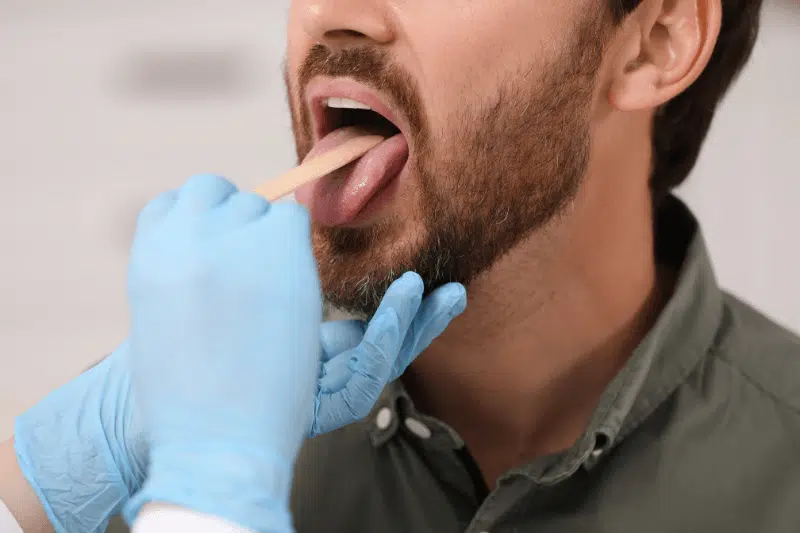
Tongue and pulse diagnosis in Chinese medicine are non-invasive methods used to assess internal imbalances in Qi, Blood, and organ systems, allowing practitioners to create highly personalized treatment plans.
At ACA Acupuncture & Wellness, many patients notice that we spend time examining the tongue and feeling the pulse during consultations. While these methods may seem unfamiliar at first, they are among the most important tools we use to understand your body on a deeper level.
Rather than focusing only on symptoms, we look for patterns. Tongue and pulse diagnosis help us uncover those patterns clearly and precisely.
Traditional Chinese Medicine, often abbreviated as TCM, uses a pattern-based approach to understanding health. Instead of focusing on a diagnosis label alone, Chinese medicine asks a broader and more functional question: What pattern of imbalance is creating these symptoms in this particular person?
This is one of the biggest differences between Chinese medicine and symptom-focused care models. Two patients may come in with the same complaint, such as headaches, fatigue, bloating, or trouble sleeping, but from a Chinese medicine perspective, the underlying reason for those symptoms may be completely different. One person may show signs of deficiency, another may show signs of stagnation, and another may show signs of heat or dampness. The treatment should reflect that difference.
At ACA Acupuncture & Wellness, our acupuncturists look at the body through several core frameworks, including:
These systems do not always correspond exactly to Western anatomy or lab-based diagnosis. Instead, they describe patterns of function and imbalance that help guide treatment.
This is why observational tools like tongue diagnosis and pulse diagnosis are so important. They allow us to gather information directly from the body in a non-invasive, real-time way. When we combine what we see on the tongue, what we feel in the pulse, and what you tell us about your symptoms, we can create a more complete and personalized treatment plan.
Chinese medicine tongue diagnosis is one of the most recognizable and informative diagnostic methods in TCM. During an acupuncture visit, patients are often asked to briefly stick out their tongue so the practitioner can observe specific visible features. While this may seem simple, it provides a surprising amount of clinical information.
In traditional chinese medicine tongue diagnosis, the tongue is considered a visible reflection of internal health. Because it is influenced by circulation, body fluids, digestion, and the condition of the organ systems, changes in the tongue can reveal patterns that may not be obvious from symptoms alone.
Practitioners do not look at the tongue casually. We assess a range of details, including:
This is what makes tongue chinese medicine diagnosis so useful in practice. The tongue gives us a visual snapshot of what is happening inside the body, and it often helps confirm what we learn through the pulse and symptom history.
Another reason tongue diagnosis is so valued is that it can reflect both immediate and cumulative changes. Some aspects of the tongue can shift fairly quickly, while others may point to longer-standing patterns that have developed over time. That makes it especially helpful for both initial diagnosis and ongoing progress tracking.
At ACA Acupuncture & Wellness, we use tongue diagnosis as part of a broader clinical picture. We do not rely on one isolated sign or assume that a single tongue feature tells the whole story. Instead, we look at the tongue in context and use it alongside pulse findings, health history, and current symptoms.
In chinese medicine tongue diagnosis, practitioners are trained to notice subtle details that may seem minor to patients but are meaningful in context. The tongue is not evaluated based on one feature alone. Instead, we look at a combination of characteristics and how they relate to the rest of your presentation.
Tongue color is one of the first things we observe because it can reflect the overall state of circulation, temperature, and vitality in the body.
A pale tongue may suggest Qi deficiency, blood deficiency, or cold patterns. Patients with a pale tongue may also report fatigue, dizziness, weakness, or feeling cold easily.
A red tongue often points to heat. Depending on the location and other tongue features, this may relate to inflammation, internal heat, stress-related patterns, or Yin deficiency with heat signs.
A purple or bluish tongue may indicate blood stagnation or impaired circulation from a Chinese medicine perspective. This type of presentation can sometimes appear alongside chronic pain, sharp discomfort, tension, or longstanding imbalance.
Color alone is never enough to make a diagnosis, but it gives us an important starting point.
The shape and body of the tongue can tell us a lot about fluid metabolism, tissue nourishment, and the strength of the body’s underlying resources.
A swollen tongue may suggest dampness, fluid retention, or a weakened digestive system. In Chinese medicine, this is often associated with Spleen Qi deficiency or impaired fluid transformation.
A thin tongue may point toward deficiency, especially when combined with a pale or red body. Depending on the overall pattern, this may suggest a lack of blood, Yin, or body fluids.
A scalloped tongue, sometimes called a tongue with teeth marks along the edges, often suggests weakness in digestion and transformation. Patients with this pattern may also experience bloating, fatigue, loose stools, or a heavy sensation in the body.
Shape gives us a sense of whether the body is struggling with excess accumulation, lack of nourishment, or imbalance in fluid regulation.
The tongue coating is another major focus in traditional chinese medicine tongue diagnosis. Practitioners assess whether the coating is present, absent, thin, thick, dry, greasy, white, or yellow.
A thick coating may suggest dampness, phlegm, food stagnation, or the presence of an internal pathogenic factor. If it is also greasy, it may point more strongly toward dampness or phlegm accumulation.
A yellow coating often indicates heat, especially when it is thick or concentrated in certain areas. This can show up in patterns involving digestive heat, damp-heat, or excess internal heat.
A very little coating or no coating may suggest depletion of fluids or Yin. In some cases, this can reflect a more chronic or deeper deficiency pattern.
Practitioners also consider whether the coating is evenly distributed or missing in patches, since that can add more detail to the pattern picture.
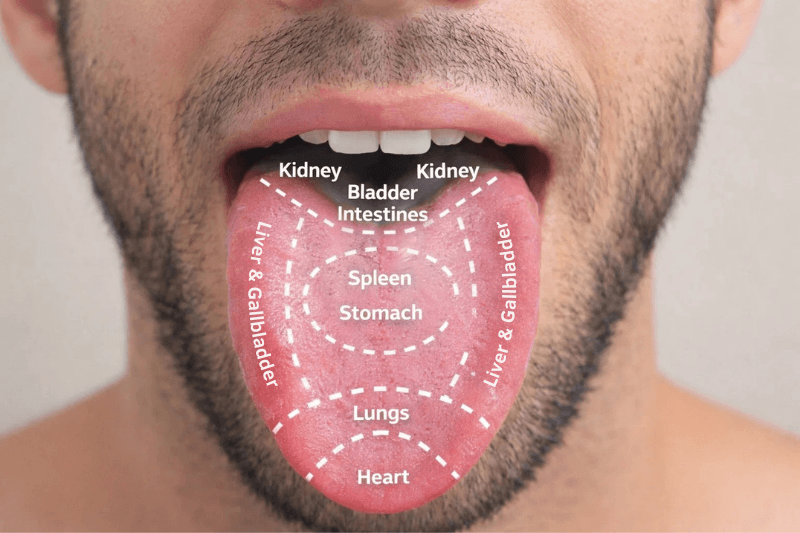
One of the most distinctive parts of tongue diagnosis is the idea that different regions of the tongue correspond with different organ systems in Chinese medicine.
This regional approach helps practitioners interpret where an imbalance may be more prominent. For example, redness at the tip may suggest a different pattern than a thick coating in the center or swelling toward the root.
It is important to note that these mappings are part of a broader diagnostic system, not a one-to-one rulebook. We use them thoughtfully and in combination with the full clinical picture.
In tongue chinese medicine diagnosis, no one sign stands alone. A red tongue does not automatically mean the same thing in every patient, just as a thick coating does not point to one universal conclusion. What matters is the combination of features and how those features align with your symptoms, pulse, health history, and constitution.
For example, a pale, swollen tongue with teeth marks may suggest a very different pattern than a red, dry, cracked tongue with little coating. Both provide useful information, but they point toward different treatment strategies.
This is one reason tongue diagnosis remains so valuable in modern acupuncture care. It helps us move beyond guesswork and toward a more individualized understanding of what your body is showing us.
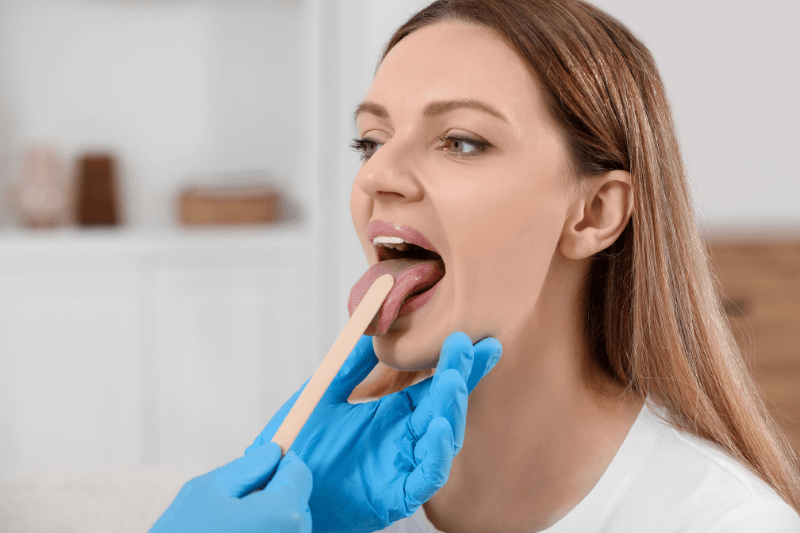
During your visit, our acupuncturists at ACA Acupuncture & Wellness may ask you to stick out your tongue for a few seconds under normal lighting. The process is quick, painless, and non-invasive, but it plays an important role in how we evaluate your overall pattern.
In traditional chinese medicine tongue diagnosis, we are not checking whether your tongue looks “good” or “bad.” We are observing specific details that help us understand how your body is functioning and where imbalance may be developing.
We use tongue findings to:
This matters because Chinese medicine treatment is meant to be dynamic. As your body changes, the signs on your tongue may change too. That gives us useful feedback about whether a treatment strategy is supporting the right direction.
For patients, understanding this process can make acupuncture visits feel much more transparent. Many people are curious about why we look at the tongue every time, especially if they feel their symptoms have already been explained. The answer is that the tongue often tells us something current and objective about your internal state, even before we begin treatment.
At ACA Acupuncture & Wellness, we see chinese medicine tongue diagnosis as both a diagnostic tool and a communication tool. It helps us refine care, and it also helps patients better understand the logic behind their treatment plan. That can make the entire process feel more collaborative, more personalized, and more grounded in what your body is actually showing in the moment.
Pulse diagnosis in Chinese medicine goes far beyond simply counting beats per minute. While Western medicine typically focuses on rate and rhythm, chinese medicine pulse diagnosis involves feeling subtle qualities of the pulse at multiple positions and depths on each wrist.
Through this method, practitioners can detect patterns that are not visible externally, offering a real-time snapshot of your internal state. It allows us to assess how Qi, Blood, and organ systems are functioning in the present moment, often revealing imbalances before they fully manifest as symptoms.
In TCM pulse diagnosis, practitioners are trained to perceive fine distinctions in the pulse that reflect different physiological and energetic patterns.
We assess three positions on each wrist:
Each position corresponds to different organ systems in Chinese medicine. By comparing these positions, we can identify where imbalances may be more pronounced and how different systems are interacting.
We also evaluate how the pulse feels at different levels of pressure:
This layered approach gives us a more complete understanding of both acute and long-standing conditions.
The speed and rhythm of the pulse provide important clues:
We also assess whether the rhythm is smooth, irregular, or uneven, which can add further detail to the diagnosis.
One of the most distinctive aspects of traditional chinese medicine pulse diagnosis is the wide range of pulse qualities we assess. These qualities describe how the pulse feels under the fingers rather than how it looks on a monitor.
For example:
There are many additional pulse qualities described in Chinese medicine, and experienced practitioners learn to recognize subtle variations that help refine the overall pattern.
For patients, it can be helpful to think of tcm pulse diagnosis as a way of understanding how your body is functioning right now.
While the tongue tends to reflect longer-term or more stable patterns, the pulse is more responsive and can change quickly based on factors such as stress, sleep, digestion, pain, or emotional state. This makes traditional chinese medicine pulse diagnosis especially valuable during each visit, even if your main symptoms have not changed significantly.
At ACA Acupuncture & Wellness, we use pulse findings to adjust your treatment in real time. If your pulse shows signs of improvement, stagnation, or a new imbalance, we can adapt your acupuncture approach accordingly to better support your progress.
In practice, pulse findings are always interpreted alongside tongue observations and your reported symptoms. This integrated approach allows us to build a more accurate and individualized diagnosis.
For example:
By combining these findings, our acupuncturists at ACA Acupuncture & Wellness can distinguish between patterns that might otherwise appear similar on the surface.
This layered diagnostic process is one of the reasons Chinese medicine is so effective at tailoring treatment to the individual rather than applying a one-size-fits-all approach.
Tongue and pulse diagnosis are never used in isolation. Each method offers a different perspective on what is happening in the body.
When these two methods are used together, they allow us to confirm patterns, identify inconsistencies, and refine treatment strategies with greater precision.
This complementary relationship is at the core of both chinese medicine tongue diagnosis and chinese medicine pulse diagnosis, and it is what allows us to create a more complete and reliable clinical picture.
These diagnostic tools are not just observational. They directly influence how we design and adjust your care.
At ACA Acupuncture & Wellness, they help us:
Because of this, your care is always evolving based on what your body is showing, not just what symptoms you report. This leads to more precise, responsive, and personalized treatment.

To ensure the most accurate results for both chinese medicine tongue diagnosis and pulse diagnosis, a few simple steps can make a difference:
These small considerations help us gather clearer information and provide a more accurate assessment.
More attention is being given to how traditional diagnostic methods can be better understood and measured using modern tools.
Some newer developments include:
While these tools are evolving, they do not replace the hands-on skill and clinical experience of a trained practitioner. Interpreting tongue and pulse findings still depends on seeing the full picture of each patient.
Tongue and pulse diagnosis are not just traditional techniques. They are precise, experience-based tools that allow us to understand your body in a way that is both detailed and personalized.
At ACA Acupuncture & Wellness, we use these diagnostic methods to make your care more transparent, responsive, and aligned with what your body is truly showing, combining observation, touch, and clinical experience to create treatment plans that are both effective and deeply personalized; alongside acupuncture, we also offer our other services to support your health from multiple angles and tailor each treatment to your specific needs.
Sources:
Matos, L. C., et al. (2021). Can traditional Chinese medicine diagnosis be parameterized and standardized? Frontiers in Medicine.
Wang, Y. Y. L. (2012). Past, present, and future of the pulse examination (脈診 mài zhěn). Evidence-Based Complementary and Alternative Medicine.
Shi, Y., et al. (2022). Correlation analysis of tongue and pulse data in fatigue populations. Evidence-Based Complementary and Alternative Medicine.
Tongue and pulse diagnosis are key assessment tools in Traditional Chinese Medicine. Chinese medicine tongue diagnosis involves observing the tongue’s color, shape, and coating, while pulse diagnosis involves feeling the pulse at different positions and depths. Together, they help identify internal patterns and guide personalized treatment.
In tongue diagnosis, the tongue reflects overall internal health. Its color can show heat or deficiency, its shape can indicate fluid balance, and its coating relates to digestion. In traditional chinese medicine tongue diagnosis, different areas of the tongue also correspond to specific organ systems.
In TCM pulse diagnosis, practitioners feel the pulse at three positions on each wrist and at different depths. They assess qualities like strength, speed, and texture rather than just counting beats. Chinese medicine pulse diagnosis provides insight into how the body is functioning in real time.
The tongue represents multiple organ systems rather than just one. In tongue chinese medicine diagnosis, different regions of the tongue correspond to areas like the Heart, Lungs, Spleen, Liver, and Kidneys, helping identify where imbalances may exist.
When used by trained practitioners, traditional chinese medicine tongue diagnosis and pulse diagnosis are reliable within the TCM framework. They are most effective when combined with a full health history and symptom assessment.
The tongue and pulse can change over time. The pulse reflects your current state, while the tongue shows ongoing patterns. Checking both regularly helps adjust treatment and track progress more accurately.
LOCATIONS
MANHATTAN
QUEENS
NEW JERSEY
CALIFORNIA
The over $4 billion US acupuncture market offers a great opportunity with over 10% annual growth rates and a continuing flow of new patients interested in the benefits of acupuncture.
