


Last Updated: July 09, 2026
The key principles of acupuncture are rooted in balance, regulation, and support for the body’s natural rhythms. The golden rules of acupuncture are simple lifestyle reminders: eat when hungry, drink when thirsty, rest when tired, and sleep early. These habits support digestion, hydration, energy, recovery, and nervous system balance before and after treatment.
Acupuncture is not only about the needles used during a session. It also depends on the condition of the body receiving treatment. Food, fluids, rest, stress, and sleep all influence how the body responds, repairs, and maintains progress between visits.
In Traditional Chinese Medicine, these habits relate to Qi, Yin and Yang, meridian flow, organ function, and the body’s ability to restore internal balance. In modern wellness terms, they connect with digestion, hydration, circadian rhythm, stress recovery, and nervous system regulation.
The golden rules should not be treated as strict medical instructions or guaranteed cures. They are practical principles that help patients support acupuncture with healthier daily rhythms.
Last Updated: July 09, 2026

The key principles of acupuncture are rooted in balance, regulation, and support for the body’s natural rhythms. The golden rules of acupuncture are simple lifestyle reminders: eat when hungry, drink when thirsty, rest when tired, and sleep early. These habits support digestion, hydration, energy, recovery, and nervous system balance before and after treatment.
Acupuncture is not only about the needles used during a session. It also depends on the condition of the body receiving treatment. Food, fluids, rest, stress, and sleep all influence how the body responds, repairs, and maintains progress between visits.
In Traditional Chinese Medicine, these habits relate to Qi, Yin and Yang, meridian flow, organ function, and the body’s ability to restore internal balance. In modern wellness terms, they connect with digestion, hydration, circadian rhythm, stress recovery, and nervous system regulation.
The golden rules should not be treated as strict medical instructions or guaranteed cures. They are practical principles that help patients support acupuncture with healthier daily rhythms.
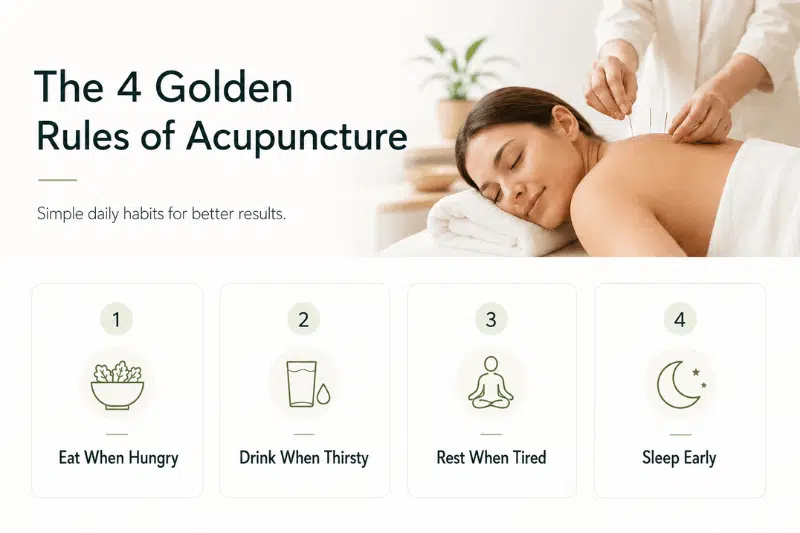
The golden rules of acupuncture are lifestyle principles that help the body stay balanced before and after treatment. They encourage people to listen to natural signals of hunger, thirst, fatigue, and sleep rather than constantly overriding the body’s needs.
|
Golden Rule |
TCM Meaning |
Practical Meaning |
How It Supports Acupuncture |
|
Eat when hungry |
Supports Spleen and Stomach Qi |
Eat with awareness of appetite and digestion |
Helps energy, nourishment, and recovery |
|
Drink when thirsty |
Supports body fluids and water metabolism |
Hydrate steadily without forcing excess fluids |
Helps circulation, tissue function, and comfort |
|
Rest when tired |
Protects Qi from depletion |
Pause before exhaustion becomes severe |
Helps nervous system recovery |
|
Sleep early |
Supports Yin restoration |
Keep a consistent and restorative sleep rhythm |
Helps repair, mood, and resilience |
These rules are simple, but they reflect a larger acupuncture principle: the body responds better when it is nourished, hydrated, rested, and not under constant strain.
The golden rules matter because Traditional Chinese Medicine views the body as an interconnected system. Eating, drinking, resting, and sleeping are not separate from health. They influence Qi, blood, body fluids, Yin and Yang, and the meridian pathways used in acupuncture theory.
Qi is often described as the body’s vital energy or functional activity. It supports movement, warmth, protection, transformation, and recovery. When Qi moves smoothly, the body is better able to maintain balance.
Yin and Yang describe the relationship between rest and activity. Yang is associated with warmth, movement, and daytime function. Yin is associated with nourishment, cooling, stillness, and nighttime restoration.
When a person skips meals, forces excessive work, ignores fatigue, drinks too little or too much, and sleeps poorly, the body may struggle to regulate itself. In TCM, this can affect digestion, fluid balance, emotional steadiness, pain patterns, and energy.
The phrase “golden rules of acupuncture” is best understood as a simplified modern teaching rooted in broader TCM lifestyle principles. The exact wording may vary, but the underlying idea reflects a long-standing emphasis on natural rhythms, prevention, balance, and daily self-care.
Eating when hungry supports acupuncture by protecting digestion and energy production. In Traditional Chinese Medicine, digestion is closely connected to the Spleen and Stomach, which help transform food into Qi and blood.
This rule does not mean skipping meals until hunger becomes extreme. It means eating with awareness. The goal is to recognize real hunger, avoid overeating, and reduce eating driven only by stress, boredom, or habit.
When digestion is strong, the body has more support for energy, circulation, muscle function, mental clarity, and recovery. When digestion is strained, a person may feel bloated, heavy, tired, sluggish, or uncomfortable.
Before acupuncture, it is usually best not to arrive extremely hungry or overly full. An empty stomach may make some people feel lightheaded. A very heavy meal may make it harder to relax during treatment.
A light, balanced meal or snack before acupuncture is often a good choice. The goal is to arrive nourished but comfortable.
Drinking when thirsty supports acupuncture by helping the body maintain healthy fluids, circulation, and internal regulation. In TCM, hydration relates to body fluids, Kidney function, Bladder function, Spleen transformation, and the smooth movement of Qi and blood.
This rule should not be misunderstood as drinking as little as possible. Thirst is one signal, but hydration needs also depend on weather, activity, diet, medications, age, sweating, and health conditions.
Balanced hydration supports circulation, temperature regulation, digestion, tissue comfort, and energy. Too little fluid can contribute to dryness and discomfort. Too much forced fluid may also feel uncomfortable for some people.
After acupuncture, gentle hydration is usually helpful. Drinking water can support comfort and recovery without needing to overdo it.
People with kidney disease, heart conditions, fluid restrictions, or medication-related hydration needs should follow medical guidance instead of general wellness advice.
Resting when tired supports acupuncture by protecting energy reserves and giving the nervous system time to recover. In TCM, ongoing fatigue may relate to Qi deficiency, blood deficiency, Yin deficiency, Yang deficiency, or patterns of overwork.
Fatigue is a signal. When the body repeatedly asks for rest and that signal is ignored, symptoms may become harder to regulate.
Some people feel calm, sleepy, heavy, or deeply relaxed after acupuncture. This can happen when the body shifts from stress into a more restorative state. Rest after treatment gives the body time to settle and integrate the session.
After acupuncture, it is helpful to avoid unnecessary strain when possible. This does not mean you must sleep all day. It simply means choosing a calmer pace if your body feels tired.
Good post-treatment choices include light walking, drinking water, eating a nourishing meal, avoiding alcohol, skipping intense workouts, and going to bed on time.
Sleeping early supports acupuncture by helping the body enter its natural recovery cycle. In Traditional Chinese Medicine, sleep is closely connected to Yin restoration, blood nourishment, emotional steadiness, and repair.
This rule does not mean every person must follow the exact same bedtime. It means sleep should be consistent, sufficient, and restorative.
In TCM, daytime activity uses Yang energy. Nighttime rest helps Yin restore and anchor the body. When sleep is short, late, or disrupted, the body may have less capacity to recover from stress, pain, fatigue, and emotional strain.
Sleep also matters in modern wellness terms. Poor sleep can affect pain sensitivity, mood, appetite, stress hormones, immune function, and concentration.
For shift workers, “sleep early” may mean protecting a consistent sleep window rather than following a traditional bedtime. For people with insomnia, the rule should not become another source of pressure. A better goal is to build a calming wind-down routine and discuss sleep patterns with the acupuncturist.

The golden rules support acupuncture by improving the body’s internal environment. Regular eating, balanced hydration, proper rest, and consistent sleep help regulate digestion, circulation, nervous system activity, energy, and recovery.
Acupuncture treatment interacts with the body’s condition at the time of care. If a person is undernourished, dehydrated, sleep-deprived, overworked, or chronically stressed, the body may have fewer resources to maintain progress between sessions.
The golden rules help reduce avoidable strain.
Eating supports Qi and blood production. Hydration supports fluids and circulation. Rest supports nervous system recovery. Sleep supports repair and resilience.
This is why acupuncture practitioners often discuss lifestyle habits. The goal is not perfection. The goal is to help the body respond more steadily to treatment.
The core principles of acupuncture help explain why treatment looks beyond isolated symptoms. Acupuncture aims to restore flow, regulate balance, address root causes, and individualize care based on the whole person.
Acupuncture aims to support the movement of Qi and blood through the body. In TCM, pain, tension, stiffness, fatigue, digestive discomfort, and emotional stress may be connected to blocked, weak, or disrupted flow.
Yin and Yang describe the relationship between rest and activity, cooling and warming, nourishment and movement. Acupuncture treatment may vary depending on whether a person shows signs of excess, deficiency, heat, cold, stagnation, or depletion.
Meridians are the pathways used in acupuncture theory to understand relationships between acupoints, organs, tissues, and symptoms. A treatment may include local points near symptoms and distal points along related meridians.
The branch is the visible symptom. The root is the underlying pattern. For example, headaches may be the branch, while stress, sleep disruption, neck tension, or Liver Qi stagnation may be part of the root.
Two people can have the same symptom but need different acupuncture strategies. Fatigue, for example, may relate to Qi deficiency, blood deficiency, dampness, poor sleep, digestive weakness, or stress. Treatment should be based on the person’s full pattern, not only the symptom name.

The best way to support acupuncture is to arrive nourished, hydrated, calm, and prepared, then give the body time to settle afterward.
Before acupuncture, eat a light meal, hydrate normally, wear comfortable clothing, and share important health details. After acupuncture, rest if needed, drink water, avoid overexertion, and notice how your body responds.
These details help your acupuncturist adjust future treatments.
The most common mistakes after acupuncture are skipping meals, overexerting the body, ignoring fatigue, sleeping poorly, and expecting one session to correct a long-standing pattern.
Acupuncture can support regulation, but daily routines shape the body’s baseline. Meals, hydration, rest, movement, and stress management all matter.

You should ask your acupuncturist for personalized guidance if you are pregnant, have a chronic illness, take blood thinners, have fainting episodes, follow fluid restrictions, struggle with severe fatigue, have insomnia, or experience complex symptoms.
The golden rules are helpful, but they should be adapted to the person.
Personalized guidance is especially important for people with heart disease, kidney disease, diabetes, autoimmune conditions, chronic pain, dizziness, low blood pressure, eating disorders, severe insomnia, or complex digestive symptoms.
A licensed acupuncturist can help interpret symptoms through a TCM lens while also recognizing when medical evaluation is needed.
The key principles of acupuncture are not limited to what happens during treatment. They also include the daily habits that help the body stay balanced between sessions.
The golden rules remind patients to eat with awareness, hydrate appropriately, rest when tired, and protect sleep. These habits support digestion, energy, circulation, stress regulation, and recovery.
At ACA Acupuncture and Wellness, our acupuncturists take a personalized approach to care. Acupuncture may be supported with lifestyle guidance, Chinese herbal medicine, ear seeding, and other Traditional Chinese Medicine therapies when appropriate. If you are working on stress, sleep, pain, digestion, fatigue, or overall balance, acupuncture care can help you better understand what your body needs and how to support it between visits.
Sources:
National Center for Complementary and Integrative Health. (n.d.). Acupuncture: Effectiveness and safety. National Institutes of Health.
National Center for Complementary and Integrative Health. (n.d.). Traditional Chinese medicine: What you need to know. National Institutes of Health.
Johns Hopkins Medicine. (n.d.). Acupuncture.
Mayo Clinic. (2024, April 20). Acupuncture.
The golden rules of acupuncture are to eat when hungry, drink when thirsty, rest when tired, and sleep early. These lifestyle principles support digestion, hydration, energy restoration, sleep, and treatment response.
The golden rules are best understood as a modern simplified teaching rooted in Traditional Chinese Medicine principles. TCM has long emphasized natural rhythms, prevention, balance, rest, digestion, and lifestyle habits.
Yes, it is usually best to eat a light meal before acupuncture. Avoid arriving extremely hungry or overly full. A small, balanced meal or snack can help prevent lightheadedness and make it easier to relax.
Yes, drinking water after acupuncture is usually helpful. Gentle hydration supports comfort, circulation, and recovery. You do not need to drink excessive water unless your practitioner or physician has given specific guidance.
Feeling tired after acupuncture can happen because the body may shift into a more relaxed state. In TCM, this may reflect the body moving from strain toward restoration. Resting afterward can help the body integrate the treatment.
The main principles of acupuncture include restoring Qi and blood flow, balancing Yin and Yang, regulating meridian pathways, treating both root and branch, and individualizing care through pattern diagnosis.
LOCATIONS
MANHATTAN
QUEENS
NEW JERSEY
CALIFORNIA

The over $4 billion US acupuncture market offers a great opportunity with over 10% annual growth rates and a continuing flow of new patients interested in the benefits of acupuncture.